
Chapter 3 - At Last A Man
In early November 1941 I went to Basic School at Cochran Field, near Macon, Georgia, where I started to fly the BT13A, a 440 h.p. monoplane made by Vultee. This school was operated by the Army Air Corps. During a solo flight one pilot reported by radio that he had a snake in the cockpit, but fortunately he landed without trouble and the snake was captured.
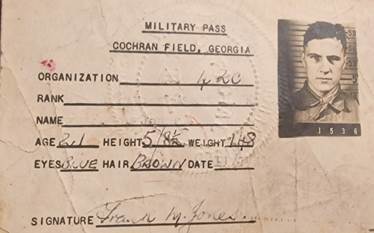
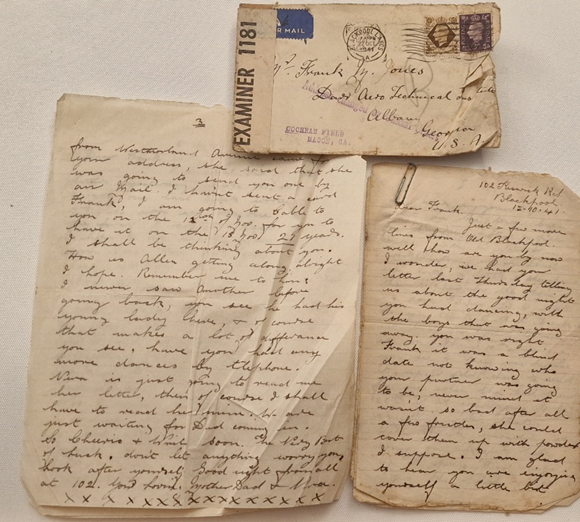
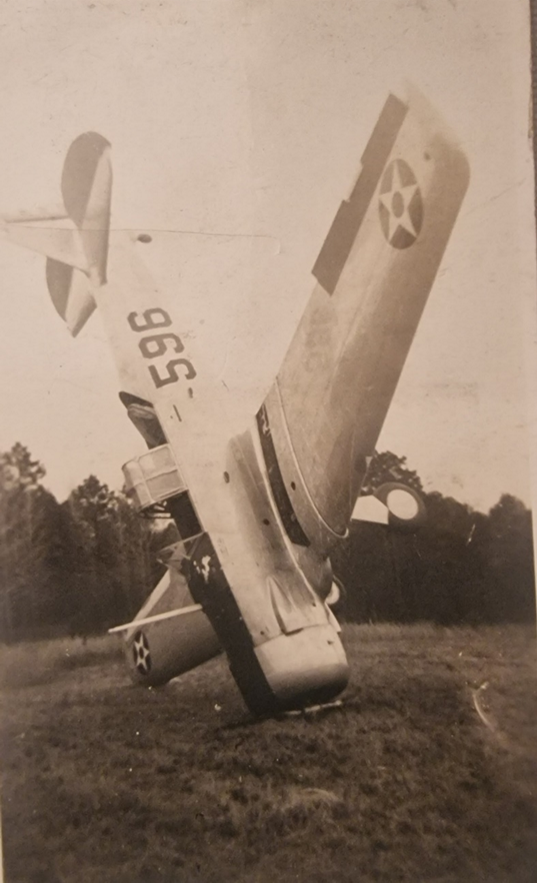
Life at Cochran was much the same as at Primary School, with flying and ground studies. From my log book, I see that part of my 21st birthday was spent flying, and I cannot recollect how I celebrated my birthday. My only claim to anything outstanding was that I crash landed a BT 13A on a golf course at Thomaston. After taking off from the field, I was uncertain of my position (lost) and was unable to maintain radio contact with the airfield. I saw a small town and made some low passes and dropped a message in my flying goggles - the message was to whoever picked it up to indicate the direction to Macon. After flying around for some time, I decided to land and unfortunately landed on a golf course, bending the aeroplane rather badly. Thomaston, a small town, printed the following in the local paper:
British Flyer Makes Forced Landing on Golf Course
Many Thomastonians no doubt thought that the war had at last reached home Monday afternoon, when British Flying Cadet Frank M. Jones of Cochran Field, Macon, made a forced landing on the course of the Thomaston Country Club.
Although the plane suffered considerable damage from the forced landing on the rough terrain, the RAF trainee received no injuries.
Cadet Jones said he left Cochran Field about 2:15 on Monday afternoon and shortly after taking off discovered that he was lost. Thomaston was the first town he sighted, and he circled the town for 3 hours looking for the airport. This incident might cite the need for an adequate airport for Upson County, the fact that an aviator, circling at low altitude, could pick out nothing that looked more like an airport than a golf course would indicate that our present landing field would hardly accommodate first class ships, even for emergency landings.
Good try Thomaston! In my fantasies I go back to Thomaston and see a magnificent airport with a gateway named the 'Frank Jones Thomaston, Airport, Gateway to Georgia', but I suppose they still have the same old landing field.
Some kind soul sent back my broken goggles, and a charming young lady called Allene Smith from Thomaston sent me a very nice letter and photograph of herself. I had two check flights by Lieutenants Patterson and McEntire, and managed to convince them that I should continue training.
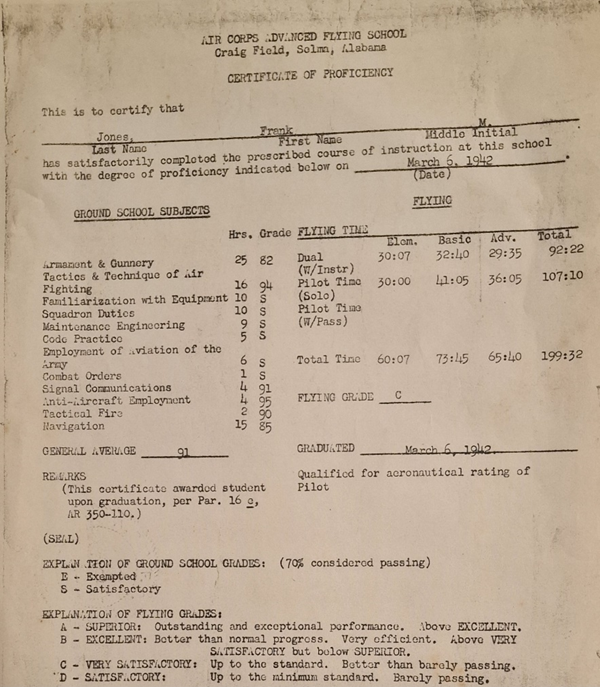
At this school I did 32 hours and 40 minutes dual flying, 41 hours 5 minutes solo, and finished with a general average ground school of 82%. I was recommended for a commission and given an above average for fighter aircraft training.
Socially I had quite a crush on Anne Johnson, a Georgia peach from Macon. She and her family made me very welcome, and I was sorry to leave Macon.
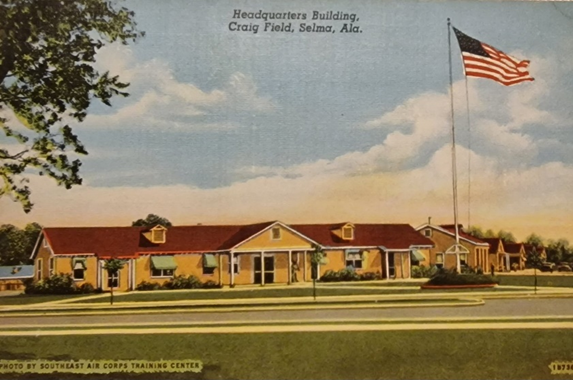
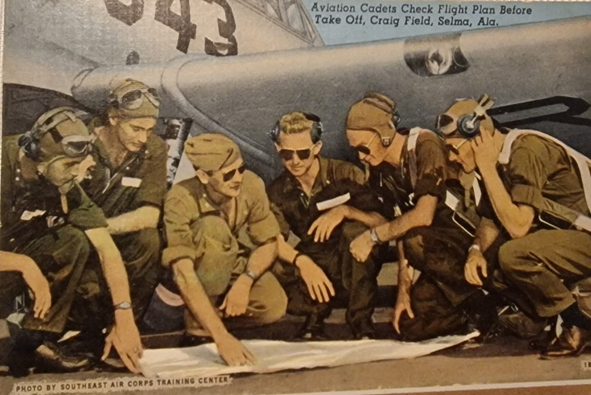
Next stop was Selma, Alabama, Craig Field, another military air base. I started flying there on 3rd January 1942, in the AT 6A, a 650 h.p. monoplane. I wrote home on 11th January and said that my first impression of Selma was good, with excellent living conditions and the discipline not as much as we’d had at Cochran Field. Out of bed at 5:10 a.m., five students to a room. The ground school covered signals, navigation, and armaments, and the following were also assessed - natural aptitude; skill in landing; airmanship and judgment; cockpit drill; instrument flying; night flying; aerobatics; formation flying; navigation and map reading; military discipline; persistence; sense of responsibility; endurance; leadership; method; deliberation enterprise; dash; distribution of attention; self-control. On 18th February 1942, I had my first flight at Eglin Field Florida, and fired 100 rounds at a ground target. Also carried out air to air firing later.
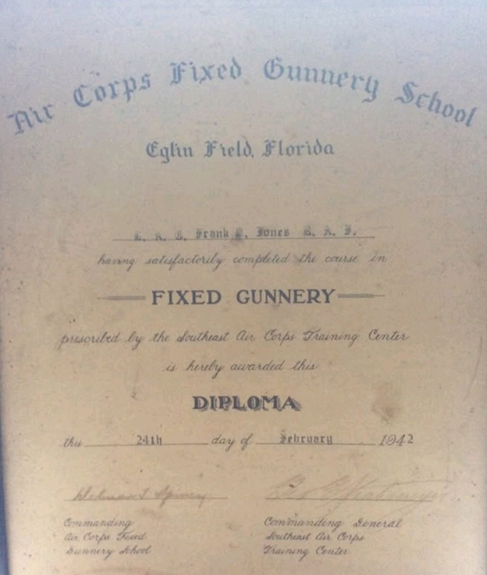
On 27th February 1942, I wrote home saying that I had been in hospital at Eglin Field with tonsillitis, that the food was poor, and I was glad to leave. The rest of the course had left earlier, some in trucks, others by plane, and I was flown back to Cochran by another student. I also said that I was a sergeant pilot to be, which was a disappointment and only a part realisation of my ambition. Ten out of thirty-three students were interviewed for commissions, and questions asked were:
- Are you a university man?
- Did you captain your school football team?
- Did you gain any certificates at school?
- How many years were you at school?
I wrote “Without a good education, a person can only go so far and no further unless he or she is exceptional. Those few years spent at high school or college bring reward later in the form of well-paid positions and openings to people and places barred to many”.
Another custom in American flying was 'star money'. Stars were given for small mistakes in flying, i.e., leaving the flaps down. The penalty was twenty-five cents per star.
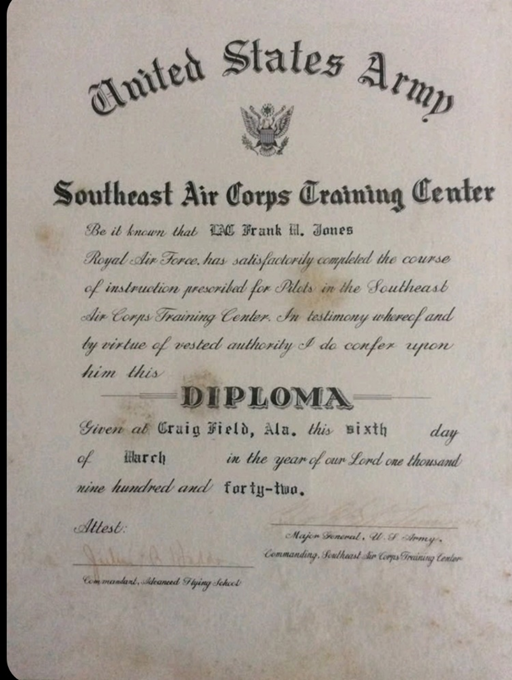
On 6th March 1942, I was very proud to receive my American and RAF Pilots Wings. Although disappointed not to be commissioned, I was now a sergeant pilot with almost two hundred hours flying experience.
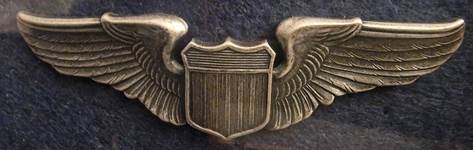
We had one American officer over six feet tall, and his favourite 'haze' was to have us all on parade and then tell us that the British had no guts. We provided an answer to this taunt by breaking rants and throwing him into the swimming pool one day - he thought this showed great spirit! You couldn't beat 'em. The 'Honour System' meant a great deal to Americans. We were given our confidential reports from the three training schools - Primary, Basic, and Advanced - and placed on our honour to hand them to the RAF authority. On our way home, the confidential envelopes were carefully opened, contents copied, and the envelopes resealed.
The Honour System, hazing, demerits and tours were all part of the American way of life, and I personally felt it was up to us to accept, at least in part, the system. We were the visitors, and in my opinion, it was not reasonable to expect the American Air Force to change or amend their training system to accommodate a comparatively few foreigners. We also had the advantage of pilots trained by the RAF in England - many of these pilots were operational with far less hours than we had.
Some of the cadets commissioned stayed in America as flying instructors, and the rest returned to England.


