
Chapter 4 - Goodbye America, Hello England!
Coming back was better than going over, because we were now pilots, even though we were 'sprog' (inexperienced). After the good living in the States, it was a bit of a shock returning to rationing. After leave, we went to a holding unit in Harrogate and waited patiently for an operational posting. During the wait I had my tonsils removed. Quick postings were not the order of the day, because the training system was unable to cope with the intake. Volunteers for the Flying Instructors' course were asked for, and I volunteered, thinking that with the possibility of a long wait for operational training, I would have the advantage of more flying experience before going into operations. Before starting the instructors' course, I went to No. 2 Pilots Advanced Flying Unit (2(P)AFU), Brize Norton, Oxfordshire, and flew the Oxford, a twin-engined aircraft. I flew the same type of aircraft at No. 6(P)AFU_T, Little Rissington, Gloucestershire. This flying was done from June to July 1942.
In July 1942, I went to No. 10 Flying Instructors School (FIS), Woolley, Reading, Berkshire, and stayed there until September 1942, flying the Tiger Moth and Magister aircraft with three flights in the Liles Master. Apart from improving flying skills, one had to master the art of teaching - you could be an excellent pilot but a poor flying instructor, the right temperament and training were essential.
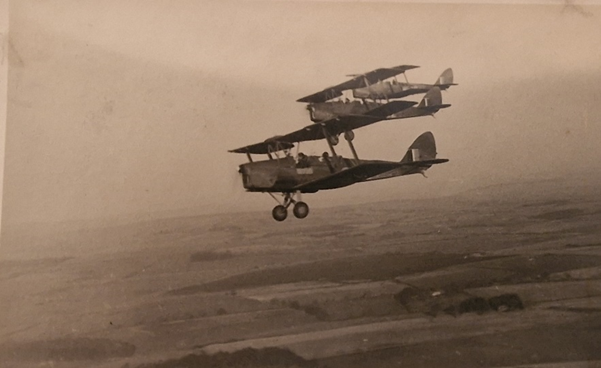
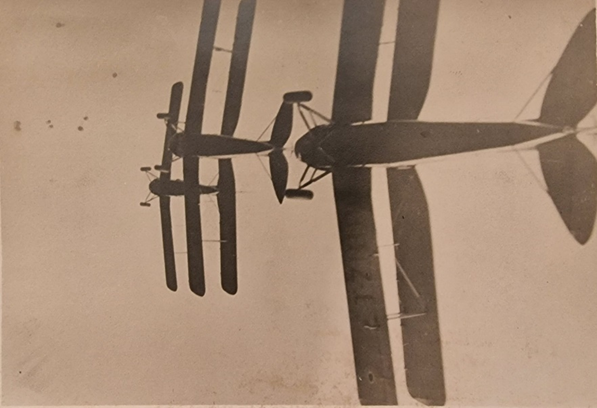
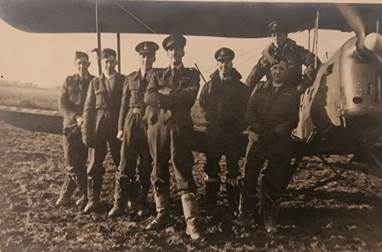
Our Officer Commanding Flying was a Wing Commander Moir, who was known as Basil Rathbone because of his resemblance to the well-known film star of the time. One of the exercises on the Final Test was the forced landing, where the Testing Officer would close the throttle and then expect the student to select a field and carry out an approach and landing without power. Basil did this to me near the airfield, so I elected to land on the airfield. After a while he said “Sergeant, do you think we can make the airfield?” I said with false confidence “Yes, Sir.” “I doubt it very much” he said. Of course I didn't, but was given another chance, and this time it worked out.
I left 10 FIS' as an average pilot and below average instructor, with a recommendation for a 'C' elementary, the 'elementary' referring to the type of training. There were three grades - L, B, C - many trainee instructors got the 'C' because at this stage they were still inexperienced and classed 'below average'.
I was posted to No. 15 Elementary Flying Training School (EFTS), Kingstown; Carlisle, and did my first flight there in a Tiger Moth on 24th September. There was one unfortunate accident where a civilian was swinging the propeller to start the Tiger Moth, and the propeller severed his arm.
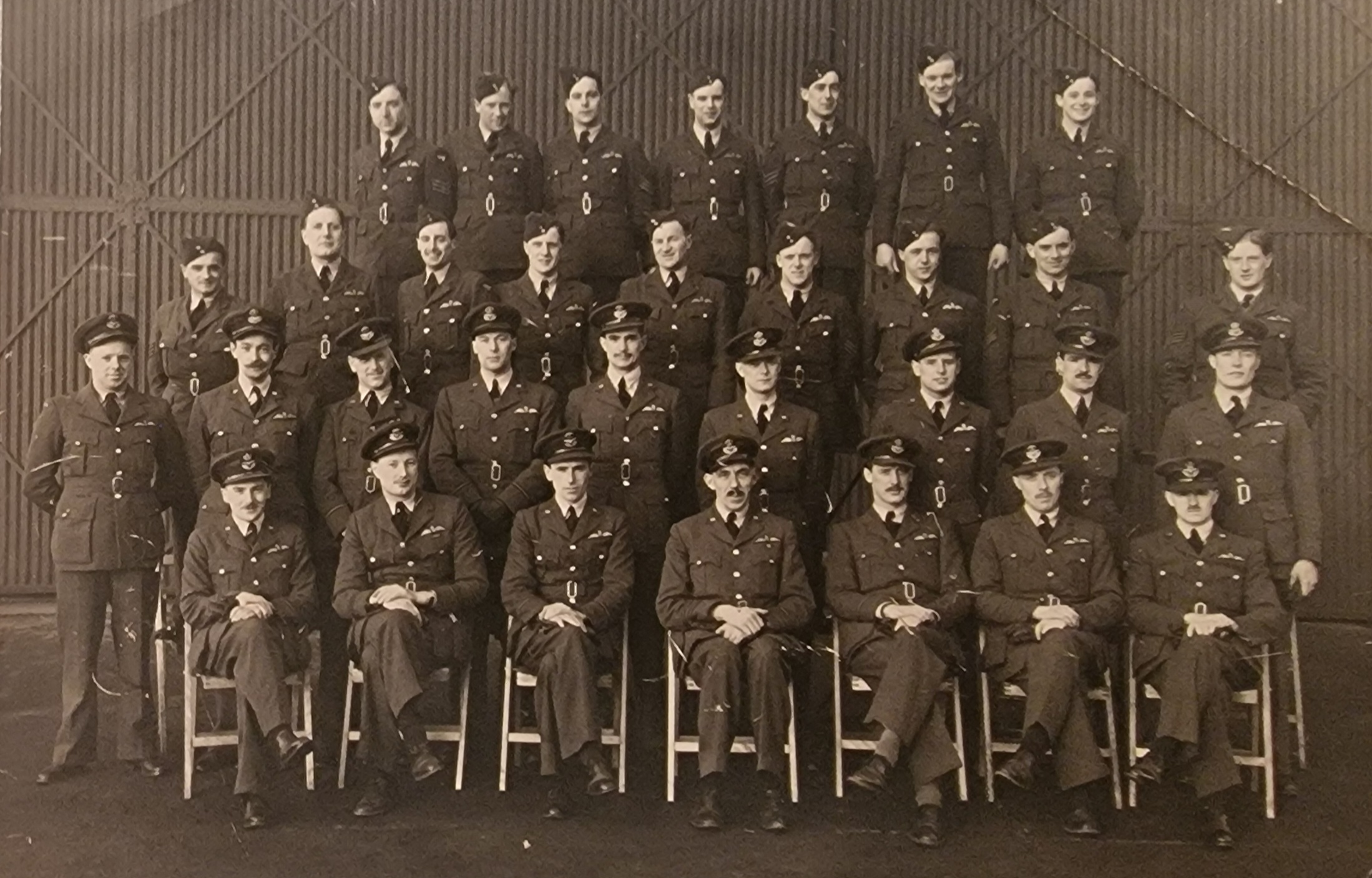
We were using a grading system which it was hoped would be a better method of selection of students for pilot training. The method, briefly, was to give the student up to approx. 11.5 hours flying instruction, with three independent checks at 5.5, 8.5 and 11.5 hours. Marks up to ten were awarded for each exercise at each check, and the student's further training was dependent upon these marks. Some students went solo, others didn't. I had just carried out an 8.5 hour check on a student, and he had done quite well and was ready for a solo flight; so I climbed out of the cockpit, and said : “O.K., off you go, one circuit and landing.” He said “I don't want to fly on my own, Sir, I promised my mother I would never fly on my own in the RAF!”
We had a relief landing ground at a place called Burnfoot, which was few miles from Kingstown; this was a very large farmer's field, eventually I went out there to live and work. I was a non-commissioned officer, and there were four of us living in the Sergeants' mess and officers living in the Officers' mess, which was in fact the next room. The messes were rooms in a converted farmhouse.
During my stay at Burnfoot, I became a Flight Sergeant. The students lived in barracks blocks and each NCO was in charge of a block. The Commanding Officer used to have a regular inspection of the blocks, and there was great rivalry between the airmen in each block to win the weekly competition for the best block in terms of neatness, cleanliness, etc. stove surrounds were often painted white, and the stove black leaded.
We didn’t have much entertainment out on the farm and had a visit from one of the smaller ENSA companies. After the show, the artistes were being entertained in the Officers' mess when there was a loud bang and the duty officer slumped against the wall, dead - he had accidentally shot himself with a revolver.
An aircraft was stationary when another aircraft just about to take off crashed into it; although both aircraft were badly damaged, no one was injured. During my stay at 15 EFTS, it became the practice to detach instructors to squadrons for a short period, to give them operational experience; psychologically, this was a good thing, particularly if a student asked his instructor if he had done any operational flying.
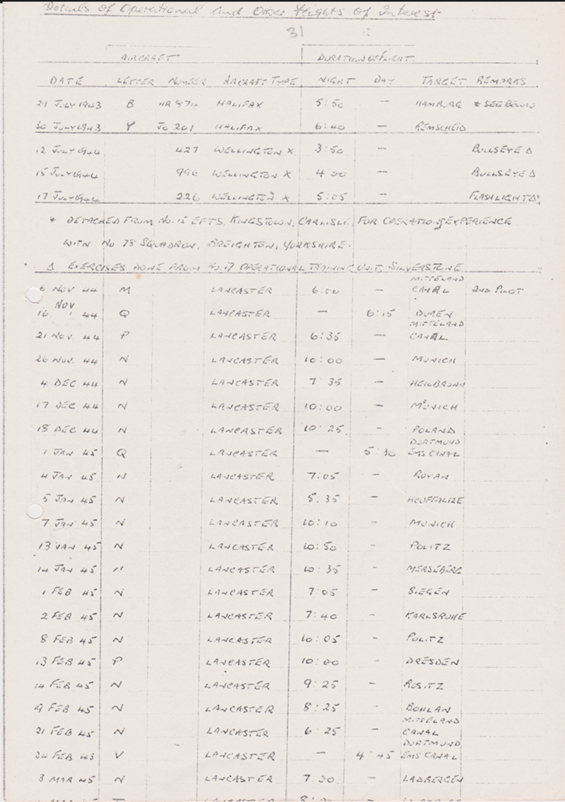
I volunteered for operational experience and was sent to Halifax. I flew as an observer with Warrant Officer Kitchen and his crew in Halifax (B Beker). A total of seven hundred and seventy-seven aircraft went to Hamburg; thirty were lost; '’window' (narrow metal foil strips) was used to saturate the German radar screens. The flight lasted 5 hours 50 minutes and the following day (30th July) I attended briefings for a raid on Remscheid. I went with Flight Sergeant Norris and crew in a Halifax (Y); the flight lasted 6 hours 40 minutes, and we landed at 04:50 hours on 31st July.
I found both these flights interesting and exciting, and on my return made out a report for the Commanding Officer. I also had to give a talk on my experience to all the pilots. In 1943, I recategorised to a 'B' instructor, and in October 1943 was commissioned as a Pilot Officer. On being commissioned, I was posted to No. 24 EFTS, Sealand in Cheshire, where I stayed until the end of February 1944.
Not long after being commissioned, I received a telegram of congratulations from the Commanding Officer of 15 EFTS on the award of the Air Force Cross, which was a pleasant surprise, and indeed a great honour, as I was a very junior officer. I have never read the citation in the London Gazette but keep meaning to do so. It is reasonable to conclude that the award was for time as a flying instructor, mainly non-commissioned.
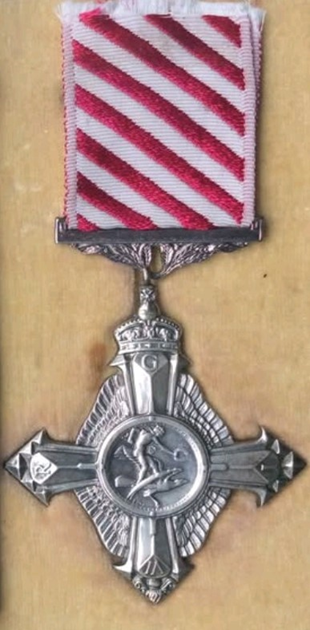
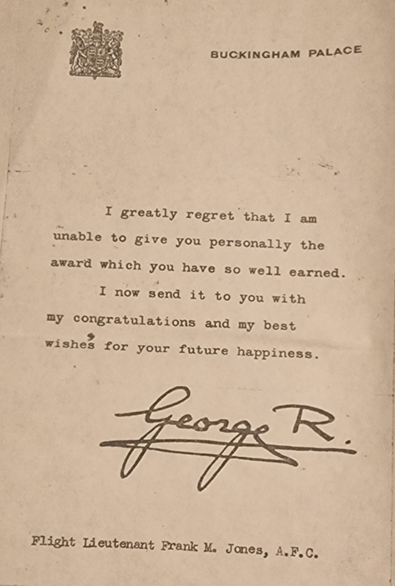
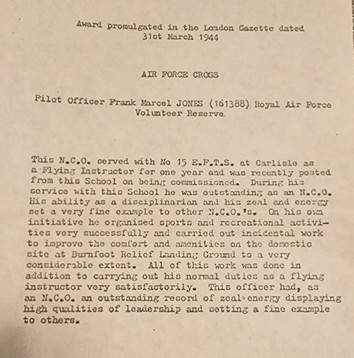
When entitled to wear the Air Force ribbon, my batman sewed it on to my best blue, and I went to a mess party. During the course of the evening, an officer whispered to me “That decoration is the wrong way round”. I beat a hasty retreat and had it changed.
Operational Training
In early March 1944, I went to No. 20(P)AFU Kidlington, with over 1,235 hours flying experience, most of this on the Tiger Moth, a biplane with no brakes and a tailskid.
I certainly appreciated how little I had known about flying when I got my wings and was grateful for the added experience when commencing operational training.
At Kidlington, I flew again the Oxford, a twin-engined trainer, and did approximately 75 hours, with cross-country, night, instrument and other flying. In May 1944, I was posted to No. 17 Operational Training Unit (OTU), flying from Silverstone and Turweston. Flying was carried out on the Wellingtons Mk III and X used earlier in the war as a bomber and now replaced in the operational role by the Lancaster and Halifax.
The OTU was particularly significant in the training system, because it was here that aircrew - pilots, navigators, air-bombers, and air-gunners - came together from their respective training schools and formed bomber crews.
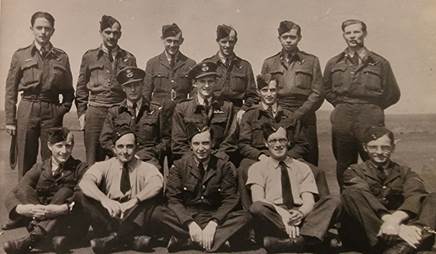
People just got together and formed a crew in the very early stages of training; this was done on a voluntary basis, and my crew consisted of:
- Frank - the pilot
- Donald - the navigator
- Malcolm - the air-bomber
- Stan - the wireless operator
- Bill - the air-gunner
- Tich - the air-gunner
I wanted so much to be a fighter pilot, but it was not to be. We carried out training, doing camera gun exercises, high-level bombing, formation and instrument flying, and we also got to know each other better.
I had a certificate in my log book which said that I had been instructed in bailing out drill; ditching and dinghy drill; oxygen drill; procedure when lost at night; standard beam approach; fire drill; petrol and oil systems.
I cannot remember anything outstanding other than a cross-country flight in the early stages; I lost an engine and flew the rest of the cross-country on one engine. It was tactfully suggested by a senior on my return that while he appreciated the ‘press on’ spirit, if it happened again, I should land as soon as possible.
We did two exercises called Bullseyes, which were cross-country flights by crews of Training Command in conjunction with British Ground Defences to enable crews to obtain experience of conditions over German targets. Under training Pathfinder crews dropped flares and marker bombs. I did approximately eighty five hours flying at the OTU. The next stage of training was the Heavy Conversion Unit (HCU), and we went to No. 1661 at Winthorpe, where we flew the Stirling four-engined aircraft which had been used as an operational aircraft. Exercises were fighter affiliation, where the Stirling was attacked by a fighter using a camera gun; the gunner used a camera gun radar, and bombing exercises. I did a total of forty seven hours at the HCU.
I went in October 1944 to No. 5 Lancaster Finishing School at Syerston, where we picked up the engineer, Sidney. We did almost seventeen hours flying at the LFS in the Lancaster. We were now ready to join a squadron and were posted to No. 57 Squadron, East Kirkby, Lincolnshire.
On arrival at East Kirkby, the Gunnery Leader was short of a gunner for an operational flight, so Tich, our rear gunner, went with another crew. Sadly, it was his first and only operational flight, for he was killed in action. I had to write to Tich's wife and try to explain what had happened. I thought of his baby, the crew had bought a baby set for him not long before the end. When Tich's widow wrote to me later, she said: "Tich and I had dreams, but it doesn't do to build castles... because I haven't met anyone as nice and kind as Tich." He was the old man of the crew, getting on a bit, in his late 20s! His death was quite a blow to us.
East Kirkby was a typical wartime airfield with Nissen huts for living quarters and messes. Somewhere I had acquired a Colt 45 automatic pistol and used to sit outside the Nissen hut firing at a target. The standard issue was a .38 revolver, but I preferred to carry the .45 with me on ops.
On 6th November 1944, I went as a second pilot with Flying Officer Donkin and his crew on a night operation to the Mittelland Canal, a round trip of six hours. After this, I flew with my crew on cross-country; high-level bombing; night flying; fighter affiliation; and on 16th November 1944 we carried out our first operational flight to Duren. This was a round flight of 6 hours 15 min by day. In between operational day and night flights, we did training exercises. As a crew, we conducted five daylight operations and nineteen at night, and our favourite aircraft was N (Nan). Our shortest operational flight was to the Dortmund-EMS Canal (4 hours 45 min), and the longest, a night raid on Politz (10 hours 50 min).
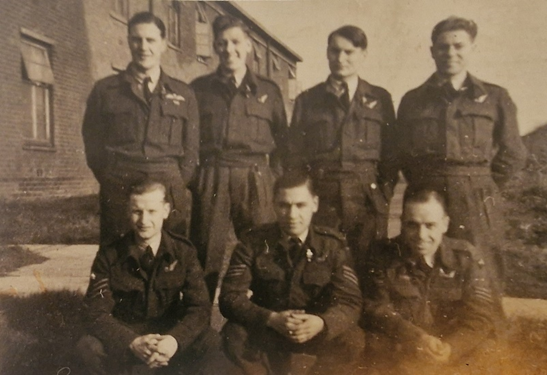
There was a big difference between Training Units and an operational Squadron. On the operational Squadron discipline was more relaxed. I well remember when I had been on the Squadron a few days, taking the band out of the inside of my hat and twisting and bending the hat until it looked "operational", something like a German officer's hat.
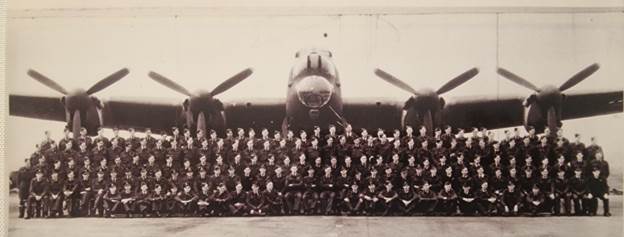
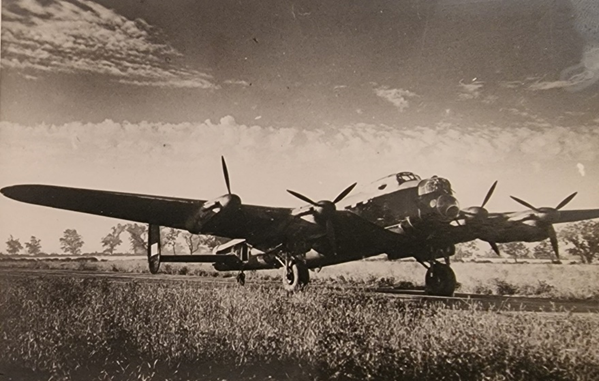
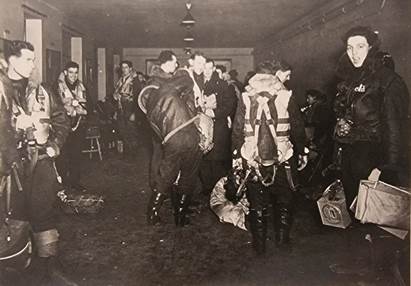
Before any operational flight, there would be individual briefings for pilots, navigators, bomb aimers and gunners, then a main briefing for all crews. The main briefing covered the routes, intelligence, weather, defences, alternative targets and any relevant information. The crew would go out to their aircraft and carry out checks, running up and testing engines and equipment, guns, etc. Before the flight, crews would have a good meal, probably eggs, bacon and chips. It always reminded me of the last supper! Then, out to dispersals to await the signal to start engines, usually a flare fired into the air because radio silence was maintained. It was quite moving on reaching the take-off point to see almost all the people not involved in that particular operation standing and waving - it was in fact the last time those waving would see some of the Lancasters rolling down the runway.
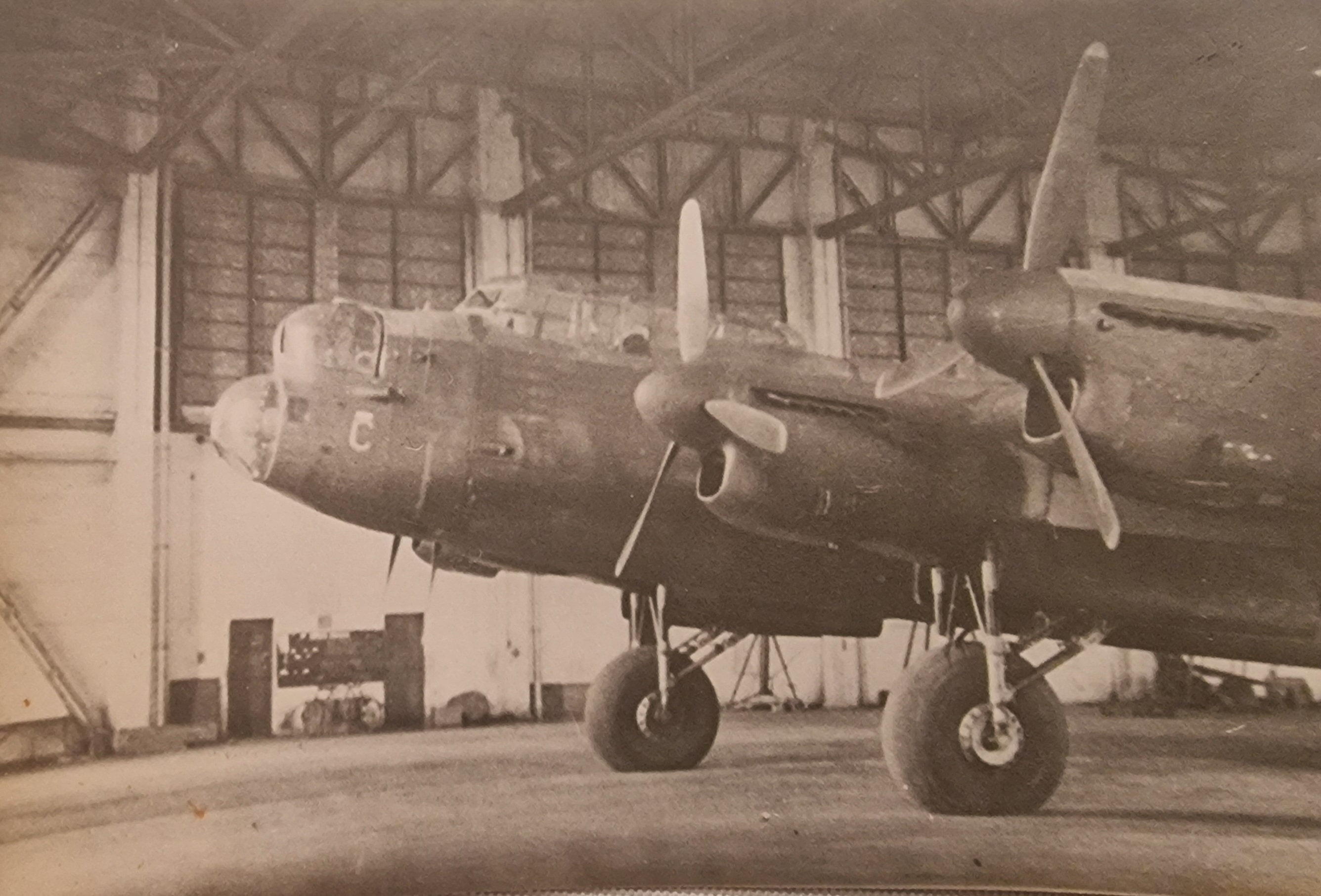
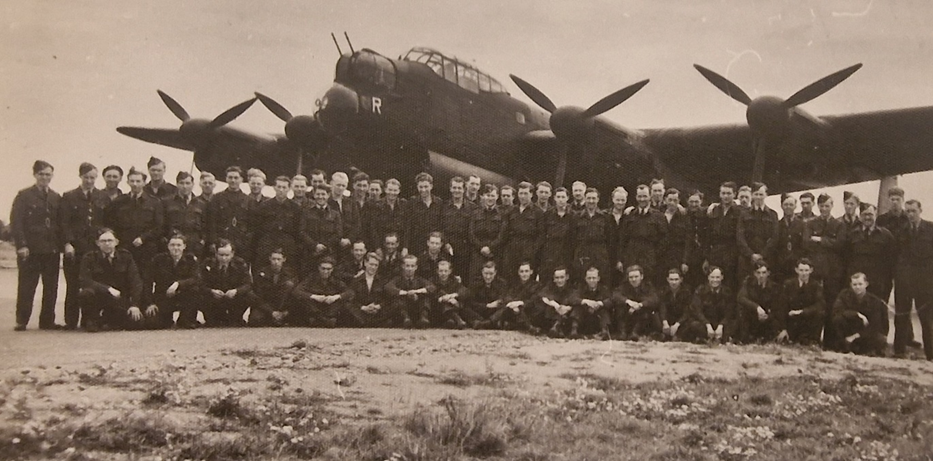
Parachutes had a regular inspection period, and it was the practice of the girls packing the parachutes to ask, at the time the inspection was due, any aircrew member to pull the ripcord allowing the cover of the parachute to open, showing that it would have opened if used in earnest. One day, when collecting our parachutes, a ripcord was pulled, the cover opened and revealed the parachute had been packed with newspapers and the silk stolen with complete disregard for somebody's life.
Operational Flight Diaries
These were usually compiled the day after the raid.
4th Operation: Munich 26th/27th November 1944
It was quite an interesting trip. We went in 'N' and took F/Lt Shaw's mid-upper gunner who was on his first trip. We took off at 23:28 hours (11 minutes late). On the way to the taxi post the W/op reported W/T trouble received and I took a big risk by taking off. The brake pressure was down to a hundred pounds by the time we reached the take-off point. After taking off, I set course right away and thank God the W/op managed to repair the set (a broken valve was the trouble). The Alps were a beautiful sight. The track marker went down on our port side about two miles away. We came up to starboard of the target just a little. Plenty of flares were dropping on Munich. I did an S turn to port and finally ran on a heading of 020°. The height was 18,000 feet. Our delay was 28 seconds. After bombing I climbed to 20,000 and left the target.
Defences: Not as heavy as I thought they would have been. A few searchlights and some flak bursting low. Received a heavy bump on the run up to the target, may have been caused by flak. On returning a twin engines kite passed from starboard to port ( observed by the A/Bomber) and came in from the port rear. It may have been a Mosquito. The M/U gave me a corkscrew to port by intercom. The R/Gunner 's guns were frozen and would not fire. The attacking A/C was soon lost and I resumed course after a few minutes corkscrewing. The engineer's mask came off and he passed out through lack of oxygen. He soon recovered when Don replaced his mask. Came back with 320 gallons of fuel after a journey lasting 10 hours. Take off 23:28 land 09:28. B/load 1-1000 lb. bomb. 13 J type cluster.
Observations: Don was sick. Gunner's microphone switches were o/s. Don being off intercom makes things rather awkward at times and the same with Stan. Lights in the fuselage! Stan flashing his torch when he went down to the Elsan. Rear Gunner (Derek) was rather worried about flak coming up and wanted window pushing out. He was also worried about the flaps, wondering whether we could corkscrew.
- Intercom control of speech.
- Reporting of flak, fighters, etc.
- Ground checks
- Search
- A/B in M/U's turret after leaving target
- Signals on call light
- Engineer's fuel log and elevator trim
- Safety Harness
- Micro switches
After leaving the target, we discovered the photo flash had not gone off. Landed with it aboard.
Op. 8 Dortmund Ems Canal
(No ground crew) The A/c wasn’t ready when we went out to collect it — no perspex covers and the engines took a long time to start. Consequently, there was a late take-off in the early hours of the morning. We went over in formation; our partner was I (the old Nan). The trip was an engineer's nightmare, with constant changing of revs and boost to keep up in formation. For some reason we stooged out at 150/155 m.p.h. (H hour had probably been put forward for we bombed late).
We met the leader on the Kentish coast, he was firing red cartridges. We were early so we orbited and broke off the orbit to catch the leader of the formation. We were over French territory before the A/c resembled a formation. On the French coast Spilsby A/c formed up and later the main force joined us. The fighter escort met us at position, Mustangs and Mosquitoes flying round the formations. Over the target there was a little flak which was very accurate bursting above and ahead.
On the way back Ginger found a bomb in the bomb bay — and we looked round for an aerodrome. Bill Harmer argued about leaving the stream and I had to tell him to keep quiet. Finally, we dropped the thing on a factory and Ging. claims he hit it. Our photograph showed a few roads and a railway (the point of release). It’s a pity we didn't press the bomb tit we might have got a photograph of the target.
Markers were dropped at positions (red, green, yellow).
The A/c were supposed to leave the target at a steady airspeed 160/170, instead they screamed out at 200+ p. h. It was a long time before I caught my partner “I”. On my way home I passed the leader LEX (630 kite) and more East Kirkby A/c were ahead.
We formatted with Fox on the way home and arrived at base a little early.
Op. 10 Heyfleus
This was definitely my worst trip so far.
We were 18 minutes late setting course. The target was in the bottle area and the marking was done by 8 Group. The control of the raid was very poor. We did a dummy run on the target because identification was difficult. On the second run, Ginger couldn’t see the T.L.’s so we didn’t bomb. I was very annoyed and wanted to go in at 5 or 6000 feet. Some of the crew started to bind, particularly the rear gunner after the target. Flak was moderate. We were diverted to Georges in Yorkshire on return. Later I had to tell the crew who was captain in the air. We landed with a heavy load (all bombs on board).
Op. 11 Munich
A quiet trip with little opposition.
Op. 12 Politz
Synthetic oil plants were the target and weather over the target was clear and the marking was quite clear. Ginger got hold of a duff wind, so we didn't get an aiming point photograph.
2 S/L’s got us Sweden?
Support run over target was finished by 22:05 we bombed at 22:17 up to B/H in "M " gear. Fight. ME 109 seen.
Op. 13 Meusberg
Synthetic oil plants were the primary target and the hour was 21:00.
We should have bombed from H+5 to 8 but bombed at H+9. There was haze over the target, and we had a little difficulty in picking out T. 1'S. Ginger's B. Tit broke so he had to use the jettison bars. There was a 14 sec delay and seeing the tit wasn't used we didn't get a photograph. VHF was noisy. On the way out we passed Frankfurt on our starboard about 10 miles away, it had a good searchlight defence, about a hundred S/L's. We arrived at the target before it was properly marked so we did an orbit to port and finally bombed at 21.09. Take-off was 16.13 for Nan. Bombing ht. 15,440 ft. in "m" gear. The crew were feeling very tired, and I had a hell of a job to keep awake. Target defences were light with a few SA's. Fast descent from target. On return diverted to Full Sutton. The circuit control was a shambles, kites were ordered to overshoot, later it turned out that Sugar 57 had taxied into a 630 kite. The drome was a Halibag drome.
Very little sleep. We couldn't put out window until after the target because the window chute blocked, there wasn't enough suction.
Op. 14 Siegan 1/2/45
This was our first trip after leave. Bad weather, snow etc., had kept us on the ground. The boys seem to be in better spirits, even Stan. Briefings were Navs 13:00, Capt's 13:30, main briefing 14:00. The target was divided into 2 parts, the marsh. yards and the town itself. One force attacked the town with incendiary and the other with H.E. We were carrying 500lb bombs and a "cookie". This target had precision works. We ran up the A/c in the morning - Stan took an examination so I had another W/op for the run up. Take-off was 15:45 and we were +14. 630 kites were late in taking off so we were held up for a few minutes. After take-off to lose time, we steered 090°. Our S/C time was 16:27 but we S/C just a little late at 180 m.p.h. On a heading of 205°. It was daylight until we were well over France. The gradual change from daylight to dusk I dislike because the instruments do not stand out as clearly as they do in total darkness, at the same time the dusk does not permit one to fly visually, particularly if cloud is about.
We went out at 7000' and climbed to Bombing Ht. at 06°E. which was 10,400’. The allied line, the part we crossed was roughly 10 miles east of 06°E. On the way out there was approx. 9/10 Sc. tops about 6000'. The weather over the continent was the same but there were more gaps in the clouds. H. hour was 19:15 and we were the 2nd force in bombing from 19:19 to 19:23 the D.L. for bombing was H+10 and min. height 6000'. The marking was to be as follows in the correct order.
- Bomb the reds with a vector wind.
- If greens were accurate they would be backed with reds. direct Bomb m.p.i. of reds and greens.
- Bomb reds direct.
- If cloud obscured target, greens cascading at 6000' were to be bombed direct. If this last method was to be used the call would have been "Sky! Sky!"
Blind greens were being dropped on the town, and then visual markers were going to drop reds on the marking point. This was the 1st plan. People with H.E. loads were to use the vector wind and incendiary loaded A/c. the direct wind. These winds were to be passed at H-5 by 5 Group Hq's.
The HE's were bombing the railway. (Vane motor leaking in front turret. Port outer coolant gauge right off the clock). The target was run up on a heading of 051°(T)and we had starboard drift. We were running just a little late when the H hour was postponed 4 mins. The red and greens were glowing through the cloud which was over the target, and we were ordered to bomb as planned, "Bomb the glow of the reds", said the controller. Ginger had some difficulty in making out the reds because the colours of bursting bombs, the greens and reds were mixing. Without warning, no corrections, still on a heading of 051°, Ginger announced "bombs going". I was taken by surprise. After the photo run I came away from the target in steps, losing 2000' A.S.i. 240 m.p.h. holding ht until A.S. fell to 200 m.p.h. then down again another 2000'. Opposition from flak over the target was light. On the Bomb run Derek reported flak bursting inside his turret!!!?? The boys are still reporting too many A/c that are miles away. On the way home had to dive to avoid a Lanc. very close behind.
Coming home I saw what appeared to be a very large red flare about ten miles on the stbd. beam. At regular intervals a green light would drop from the red. Over the sea we saw what appeared to be a large torch flashing a series of dots. Both the above were reported to Intelligence on return. A lot of importance was attached to the light on the sea. Over the sea not long before we reached our coast the weather was very rough; we were tossed around and the A.spd. started to ice-up at one time but soon returned to normal. Poor Don was sick. These rough weather conditions persisted until we were almost at base, we were in and out of cloud at 1500'. Cloud base at base was about 1300'. VHF was weak with a very noisy background. R/T. at base was poor. I was no. 40 to pancake - 39 went round again. I was given permission to pancake but a 630 kite without R/T cut in and I had to go round again. The whole trip took 7.05 hours. The landing was a lovely 3 pointer.
The main faults with the trip were as follows:
- No instruction from Ginger on the bombing run.
- Microphones were left on.
- Too many A/c and odd things reported.
- E.T.A's from Don had to be asked for.
*Bombed actual time 19:23
Dons QFF on return was 1007
My QFE on return was 1000
TOR +35
N.B. Callsigns }
M.F. Drawstring } RAIDS ON MAIN Z MANNERHEIM
C.B. Astrodome }
A.M. Ludo }
Op. 15 Karlsrue
There was a lot of fighter activity on this raid; 5 group lost 14 A/c. There wasn’t much excitement for us and we bombed at 23:22 bombing the green glow of the markers through the cloud. The boy (Ginger) saw a Lanc. go down and the boys saw a combat, at least they saw the tracer. My landing on return was p. poor. Flak was light.
05/02/45
Had the crew together today and we had a chat on crew cooperation. Lots of points were brought up and thrashed out, including the question of old Ginger going to sleep on the 15th Op. Am not very satisfied with Derek, he is still very unstable.
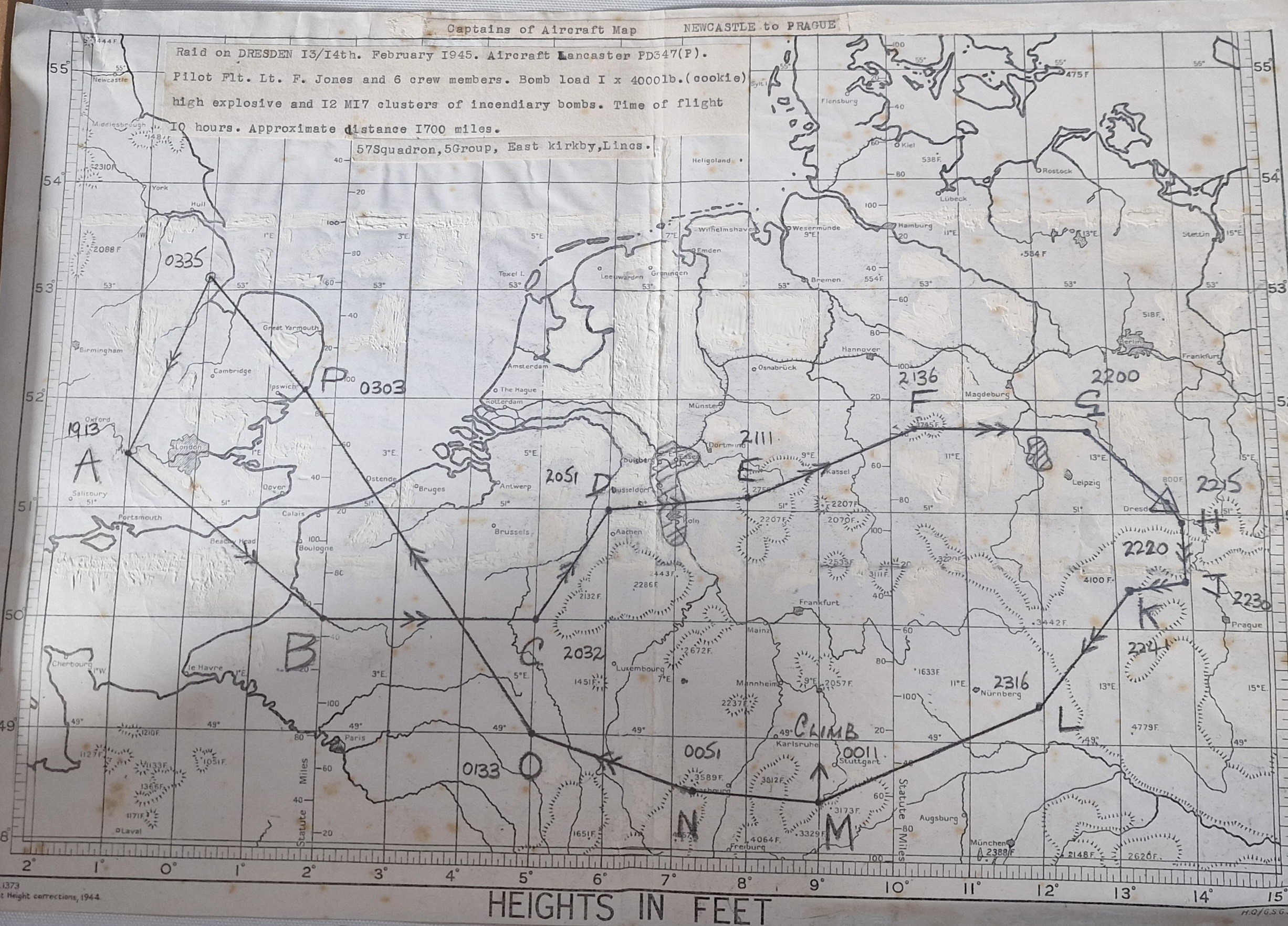
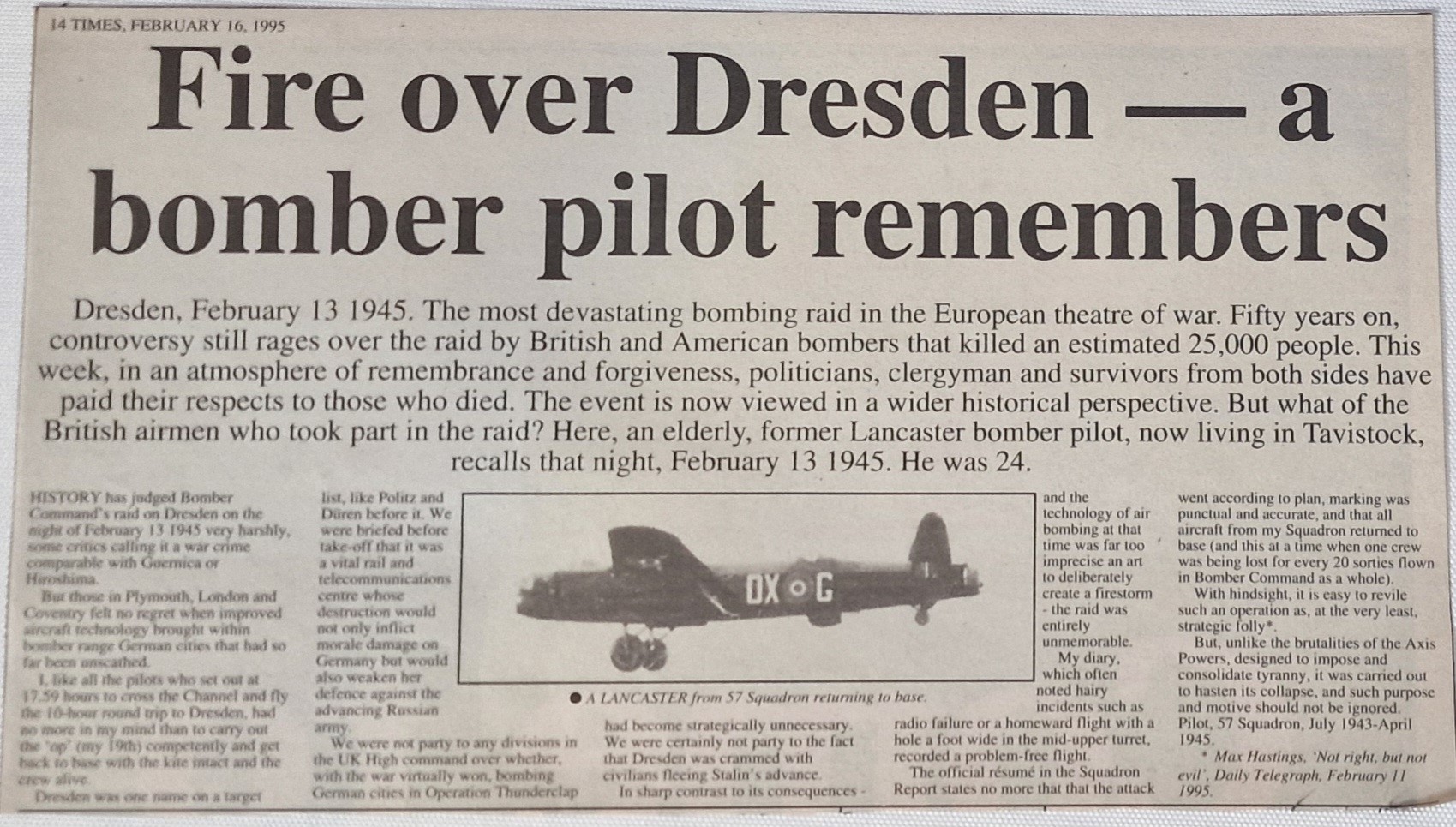
Op. Dresden 13/14 February 1945
Crew:
- F/L Jones - Pilot
- SGT. Baker - Flight Engineer
- F/O Watkinson - Navigator
- F/S Campbell - Air Bomber
- SGT. West - Wireless Operator
- F/SGT. Moody - Mid Upper Gunner
- SGT. Harmer - Rear Gunner
- Aircraft: Lancaster 1 (PD 347 - 'P')
- Take-off: 17:59 Landed at 04:03
- Total time: 10 hr 04 min
- Bomb load 1 x 4000 H.C. 12 X M17 Cluster
57 Squadron Report
The first attack by Bomber Command on Dresden.
The marking was punctual and accurate. Crews were ordered to attack the glow from red target indicators. Results were difficult to assess at the time owing to cloud, but subsequent reports prove that the attack was very successful. The attack went according to plan and the glow from the fires could be seen 150 miles away on return.
Ground defences were negligible and very few fighters were seen.
Weather 10/10ths; medium cloud, dense about 15000 feet with a thin layer of stratus at about 6000 feet, visibility good in between.
Times of attack - 22:12 - 22:13.
Heights of attack - 12000 - 15250 feet.
Sortie successful. 18 aircraft detailed, all returned to base.
Op. Rositz 14/15
An oil target about 50 miles west of Dresden which we visited last night. Take-off was 16:40 and I was +7; we took off on time and set course right away climbing on track, we lost time by dog-legging between base and Reading which was our first turning point. The sun was very strong and was shining in my eyes making it difficult to see the D.R. repeater, I set the wrong course on the repeater 10° out to correct but corrected it after about 2 minutes flying and after I had told Don we had been flying starboard of track. We made our first turn dead over Reading. George flew the A/c for a considerable period - I am making more use of the automatic pilot on these long trips. Ginger and Sid took turns sleeping on the way out while it was daylight, also the gunners took turns at relaxing, although I doubt if they ever relax.
Weather on the way out was quite good with some haze, I was at 8000' on the way out and later climbed to 9000'. Approaching the target, we ran into very bumpy cloud so I climbed to 13000' and was just on the tops of it. V.H.F. was rather noisy (B alt. A.). Coming up, we saw 2 targets and were not quite sure which was ours. The one on the sbd. was certainly getting a pounding but the bombing, incendiaries, was very scattered.
We took the target on the port side, which actually was ours but Ginger couldn't identify the marking so I did an orbit to starboard and came down through the cloud to B. Height of 8,750 and at Ginger's request dropped to 8000.
Op. 19 Bohlan 19/20 Feb.
The marking of the target was a little more complicated than usual. The following was the preference of bombing.
- Reds as planned. Blind markers were to drop greens on the target itself at H-11 then Mosi’s were to go down and mark the marking point with T. reds; main force were then to bomb on a track of 314(T) with a delay of 12 secs. At H-9 flare wave (one flare wave)).
- Bomb the greens (primary, if accurate) direct).
- Bomb red and greens direct if greens needed backing up with reds.
- Bomb reds direct. If aiming point needed remarking.
- If controller thought it necessary he was going to order a new marking point to be marked with (reds?) and give a new track and delay probably 277(T) 24 secs delay.
- As a last resort Leipzig to the north a few miles away was to have a wanganci attack (green markers with red stars).
There was a lot of S/c around base so we were briefed to maintain the QDM of the runway until clear of the cloud and then to set course. The trip out was uneventful, we saw a pinpoint of light (white) going upwards very rapidly then it changed to a yellowish light then disappeared, not being able to identify it we reported it to Intelligence on return. The front line was approximately 6.5°E. We were briefed to go out to 5.5°E. below 5000' then up to a ht. band of 7/9000’ to 8°E. then down again to 5 to 7000' until 11° E., then up to B. Height of 10,600.
As we made our last turn into the target (position H) we could see lots of flak coming from the port bow, we were still in patchy cloud and came down to 9,600 to bomb. We saw red T.I's on the starboard I ran up on them about 20 minutes past four. At that time, we couldn't see any bomb bursts from other A/c, may be the cloud was covering them. 10/10ths of cloud over the target.
Op. 20 Gravenhorst
This was one of the best attacks we have done so far from a weather point of view and marking. The marking was good and clearly visible for miles before we arrived. The controller's instructions were to aim at the most northerly T.I. There was a moderate amount of light flak going up but we experienced no difficulty over the target. On the way home just after clearing the target the m/ upper reported numerous A/c going in on fire, chiefly from light flak, two of them from what appeared.
Op. 21 Dortmund Ems Canal 24/2/45 Abortive
We thought this was going to be an early morning show but take off was 13.45 and I was plus +15. Another 5 Group effort and we were carrying 14 one thousand pounders - with a delay.
I took "Victor”, a Lanc. usually flown by F/o Cobern. There was another attack to the south, I can't remember the name of the target.
The marking was to be as follows - yellow markers cascading at 1500 feet were to go down on the gates to the south of our aiming point and these markers were the aiming point of. Lancasters carrying 12,000lbers.
A mile north of the target red and green flares were to go down to indicate the turning point for return. Here is what happened.
We flew out in good weather conditions until we reached the Dutch coast where cloud overland was 10/10ths. except over the Zuider Zee where it was clear. At the Dutch coast the VHF was switched on Channel D and as we flew over Holland the conversation between two members of a crew was transmitted, their conversation dealing with what colour cartridge should be put in the pistol and then there was a discussion on window. The control of the raid was poor, no instructions were given except to turn port and tighten up the formation. A little heavy flak came up in the vicinity of the target bursting about 13000' the height we were flying; barrage flak coming up through the cloud. The whole raid was a bit of a shambles. 57 and 630 squadrons formed up over base in formation and picked up another squadron at Hunstanton and another squadron at Cromer. The leader of the wing was firing red pyrotechnics so we could form up. It was very difficult keeping in formation with different speeds. On the way home we jettisoned a 10001ber to reduce weight to 58,000 for landing, the bomb was jettisoned in the sea. We had a fighter escort of Mustangs and Mosquitoes who were buzzing around all the time. The whole trip amounted to a navigational exercise and on return to base I was +5, we made a beautiful 3 point landing but had to turn off the end of the runway at high speed to avoid another aircraft coming in to land.
For the navigator it was a holiday. His gee box started to smoke so had to be switched off. The raid was to be done in formation.
The main force call was “Housefly”.
Details of Operational and Other Flights of Interest: