
Chapter 5 - The War Continues...
Three Wartime Stories
If the runways were obstructed for any reason, it was usual for returning aircraft to be stacked at various heights; on this particular night, individual aircraft returning were ordered to stack at a particular height, so aircraft were orbiting the airfield from 1000 ft to 5000 ft with 500 ft separation. After a long flight, this procedure was very tiring to pilots, so after half an hour of orbiting the airfield, a disguised voice came over the radio and said: 'I am a bit of a c----'.
This transmission was received in Air Traffic Control, where the Station Commander - a Group Captain - was casting an eagle eye over proceedings, The Senior Air Traffic Controller (SATCO) - a Squadron Leader - thought it better to ignore the transmission, so nothing was said. Another 5 minutes went by, and the voice came up again: 'I am a bit of a c---'. The Group Captain looked at the SATCO, who looked embarrassed, but said nothing. 5 minutes went by, and the voice said again: 'I am a bit of a c---'. The Station Commander could stand it no longer; he said to the SATCO' Get that pilot's call sign'. The SATCO, almost at attention, said: 'Yes sir, right away'. He then called: 'Aircraft transmitting, what is your call sign?' There was a long silence, then the voice said: 'I am not that -much of a c---'.
***
Altitude is measured by setting millibars or inches on the altimeter - in millibars on British aircraft and in inches on American ones. The standard pressure setting is 1013.2 mb, or 29 in. On this particular day, a lady Ferry pilot flying an American aircraft called on the radio for an altimeter pressure setting and was given 1013mb. She replied: 'I would like "it" in inches'. Air Traffic replied, '29 inches'. Quick as a flash, an American pilot said: 'Feed it to her gently, Mac'.
***
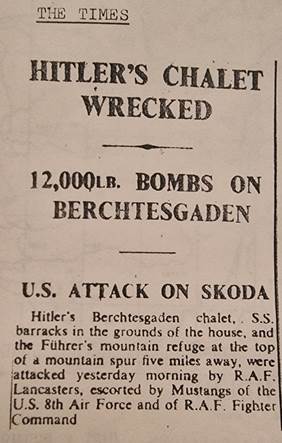
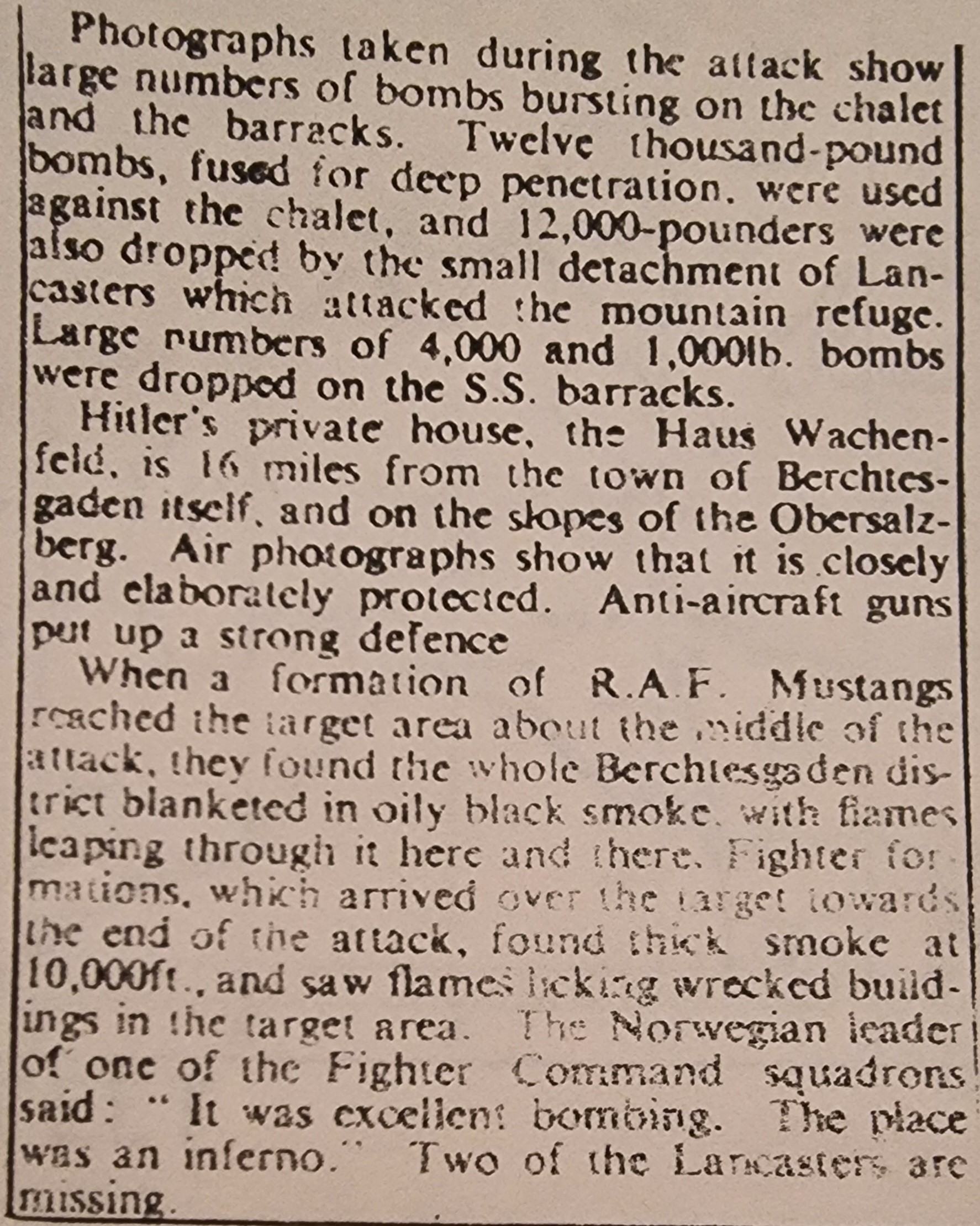
The raid on Berchtesgaden was, I think, the last raid of the war, and was radio controlled. We were bombing the SS troops, and another Bomber Command Force were bombing the Eagle's Nest, Hitler’s bunker. We were using a standard 10000 lb. bomb load, but the bombers attacking the Eagle's Nest were each using one large bomb carried by specially adapted Lancasters. On the run into the target, one of the Lancasters was having difficulty releasing its bomb; the pilot called on the radio for instructions as to what he should do. His leader's prompt reply was: 'Stick it up your arse, I’ve got my own problems’.
We fell about laughing at the crude humour; it didn’t seem out of place at the time.
***
With 57 Squadron
During my stay with the squadron, I had to investigate an accident. A Lancaster had been seen rocking its wings violently before landing in the sea near Skegness. Unfortunately, it had ditched with a full bomb load and blew up on impact.
I found during the investigation that a switch had been fitted which cut out the jettison circuit, and this fact, published in orders, had not been signed by the crew. From eye-witness accounts, the attempted ditching had been perfect, the rocking of the wings had been an attempt to shake the bombs free.
Still With 57 Squadron
In a remarkable sequence of events on 17th April 1945, 6 of No. 57 Squadron's Lancasters were blown up or wrecked. The Squadron was bombed up with a mixture of 500 and 1000lb bombs, some with a  hr delay and others with a 1-hour delay. Crews were due to go out to the aircraft between 17:30 and 18:00 hr. At 17:40 the first explosion took place: bombs were still exploding the following morning. Flying Officer John Gott, a friend of our crew, did a great job getting the injured away. Then a navigator, a former policeman and (post-war) a chief constable, he already held the George Medal and was again decorated for his work during the explosions. He used to run around in an MG. He was a keen rally driver and was killed in an accident years later. In the explosions, 3 servicemen were killed and 14 injured, and there were 2 civilian casualties.
We took part in one of the last, if not the last, raids of the war; a daylight flight in 'N' (Nan) on 25th April 1945, to bomb the troops at Berchtesgaden, a flight which lasted 8 hours 15 minutes. We were the reserve crew for this raid, and our ground crew knew we were keen to go. The Lancaster pilot in the dispersal opposite was having trouble in starting one of his engines, so the NCO in charge of the ground crew looking after 'N', with a broad grin and a 'nudge, nudge' attitude, said he would go and give them a hand. He was back in a few minutes beaming and shouted: 'Ready to start up, Sir? You are going on this one'.
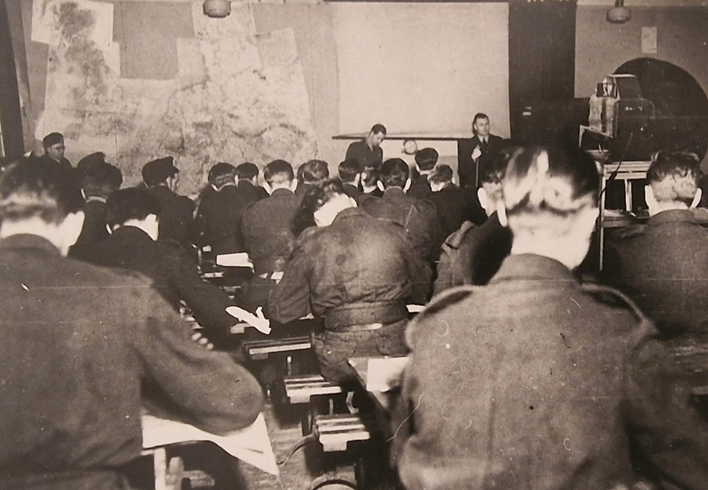
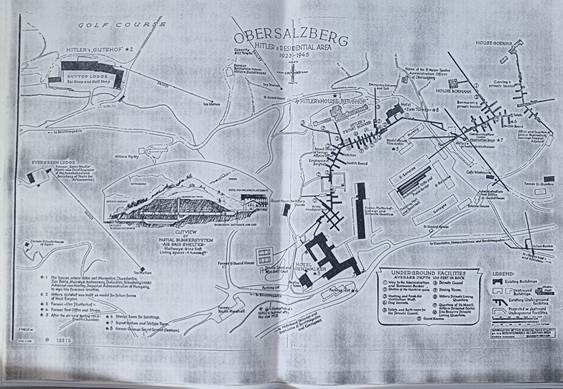
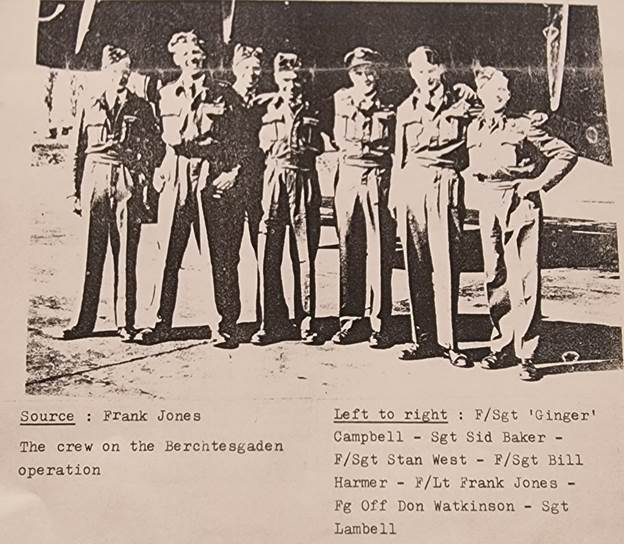
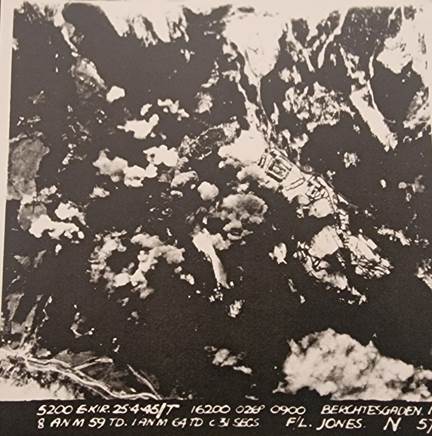
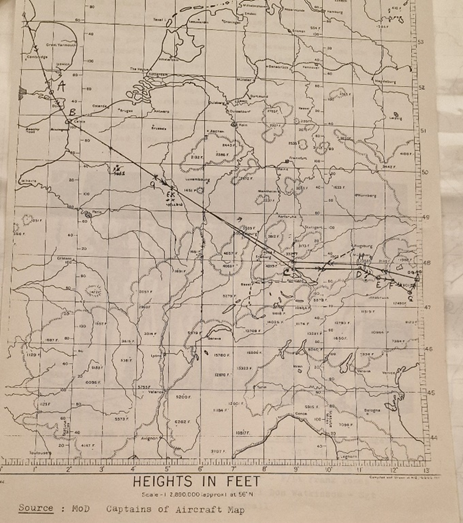
The barracks rectangle was quickly obscured by the bomb bursts. One or two crews reported that bombing was not well concentrated, and many overshoots were seen. Several aircraft bombed near the railway bridge north of the target and some bombs fell in Berchtesgaden village. The main trouble appears to have been that the high mountains on the run in prevented some crews from seeing the target until it was too late. No enemy fighters were seen. Moderate heavy flak at the target and from Salzburg. Later reports confirm hits on the SS Barracks and hits by another force on Hitlers Hide-out. One aircraft didn’t bomb.
The war in Europe over, we brought back ex-prisoners of war from France, Belgium and Italy.
It is interesting for me to note that I had a categorisation check in a Lancaster with a Flt. Lt. Beetham, and later I flew with him as a navigator in an Oxford on a cross-country flight to Hendon. My monthly flying times in the log book were certified correct by Squadron Leader M. Beetham, Officer Commanding 'B' Flight, 57 Squadron: he later became Air Chief Marshall Sir Michael Beetham, G.C.B., C.B.E., D.F.C., A.F.C., A.D.C., Chief of the Air Staff Royal Air Force - my progress was far less distinguished!
The first Lincoln Trials Flight was specially formed at RAF East Kirkby, with me in command. I had 3 Lincolns - RF385 (G), RF386 (Y), and RF387 (F). In August 1974 I sent my memories of the Avro Lincoln to Mike Garbett and Brian Goulding, authors of 'Lincoln at War- 1944 -1966'. Some of these memories were included in their book first published in 1979. During the Lincoln trials, 57 Squadron moved to RAF Scampton and on 26th January 1946 I did my last flight in a Lincoln RF386, 2 hours of formation and instrument flying.
It was also my last flight in the Royal Air Force, which I left in July 1946. A reprint of my impressions of the Avro Lincoln, given in August 1974, can be viewed [here].
During my operational tour, I kept a diary of sorts; this was usually written up the day after the raid. It has been reproduced as it was written and is dedicated to those men I had the honour to serve with, my crew Don Watkinson, Malcolm Campbell, Stan West, Sidney Baker, Bill Harmer, and 'Tich' Bayford.
In 1946, I became a civilian with an undecided future. I went back into the family business, the motor driving school, but I could not settle down so eventually became a manager in the wholesale and retail wine and spirits trade. I then gave up the job of manager and went into the retail wine and spirits trade on my own, renting a greengrocer’s shop and turning it into a wine and spirit shop in Blackpool. In 1948-50, I flew the Auster aircraft owned by the Blackpool and Fylde Aero Club, just pleasure flying.
In 1950, I saw, and replied to, an advert by Airwork Ltd. for ex-RAF Flying Instructors; I applied and received a telegram saying that I was accepted. I sold the business, and joined Airwork in January 1951 at No. 2 Grading School, RAF Digby. I was then commissioned as a Flying Officer in the Royal Air Force Volunteer Reserve. All civilian instructors had to be in the RAFVR. Our students were Royal Air Force cadets. I eventually became a Flight Commander; back to flying the Tiger Moth, and I well remember when we were allowed a dual trip in a Chipmunk - a one-off job!
My outstanding memory of RAF Digby was when I married my dream girl Lucy in the little town of Sleaford on 3rd March 1951. We had our 'working' honeymoon in Dorrington, staying in a bungalow once used by Frank Whittle, designer of the jet engine. The bungalow was right opposite a church graveyard, and I woke up one night in a sweat after seeing a horse galloping through the window. Many weeks later in the local pub, somebody asked me if I had ever seen the galloping horse - it made me think. One day, a freak storm hit RAF Digby, and as the Tigers came over the boundary to land, on touchdown several turned over, but no one was hurt. Lucy, my wife, was employed as a timekeeper by Airwork, which was quite a change from being a nurse. In 1953, the future with Airwork was not very bright, so I applied to the Royal Air Force for a short service commission. During my stay with Airwork, I recategorised to an A2 instructor, the recategorisation being one by a Royal Airforce Instructor from the Central Flying school
The Avro Lincoln
When asked by the author to write about the squadron trials of the Lincoln and to give my impressions of what at the time was known as the “mightiest bomber in the world” I realised with an unpleasant shock that I was almost 29 years older since flying for the first time the new shiny big sister of the Lancaster.
The Lincolnshire (using the modern phonetic alphabet) ‘yankee’, ‘foxtrot’ and ‘golf’ arrived at East Kirkby for squadron trials and crew conversion in September 1945 and the crew and I flew in Lincoln ‘yankee’ on the 9th September 1945 and carried out circuits, landings, overshoots, stalls, 2 and 3 engined flying. Today, the one clear membrance of that flight was the considerable flexing of the wings. I read later that under loading destruction tests the wing flexed eight feet at the tip before failing. What a relief!
Time has unfortunately dimmed the memory, so I have to quote interview by reporters from Flight and Aeroplane of 1945.
“Flight Lieutenant F. M. Jones who commands the Lincoln flight of 57 Squadron takes a very good view of the aircraft, but as is to be expected, having done a great deal of time in Lancasters, he is not too willing to agree that the Lincoln is greatly superior from the flying point of view. He did say, however, that the Lincoln is rather more stable and holds its trim with remarkable accuracy. In view of the Lancasters qualities in this direction, this is indeed precise.
Flight Lieutenant F. M. Jones who has 1800 hours to his credit has done a considerable amount of test work on the Lincoln and says from the point of view of handling qualities the aeroplane shows definite improvements over the Lancaster, especially with regard to stability in the longitudinal place”.
From memory the stall was very gentle with no tendency to drop a wing and recovery was immediate. With flaps and undercarriage down the stall secured around 65 knots indicated air speed.
Crews had no difficulty in converting to the Lincoln because it was an aircraft that had no vices and was a pleasure to handle but it was understandable that pilots who had extensive experience of the Lancaster were unwilling to concede its pride of place to any other aircraft, even a bigger and better Avro machine.
The Afro Lincoln mark 11 B had Packard Marlin 68 motors which were the United states brief version of the Marlin 85 as fitted to the Lancaster mark V1B. ground crews regarded the Lincoln with affection from the point of view of servicing and maintenance because the aircraft was a definite improvement on the Lancaster the motor Cowling side sections were hinged to fill down and provide servicing platforms.
For dealing with Japan became apparent that the Royal Air Force would need a long-range aircraft with high performance capable of handling heavy bomb loads and the Lincoln was the answer but of course it did not have the opportunity to prove its operational worth. It remarkably resembled the Lancaster and came from the same stable it was considerably larger and heavier than the Lancaster which was produced from the Manchester twin engined heavy bomber.
Armament consisted of two D50 machine guns in the nose turret and two in the tail turret with two 20mm British hispano cannon in the mid upper turret. The bomb aimer had the luxury of a seat in the new faceted nose compartment. The aircraft had white painted upper surfaces to act as a heat reflector when used in the tropics and underneath was painted black.
I was involved with the Lincoln from early September 1945 until January 1946 at Royal Air Force East Kirkby and Scampton and did 42 hours and 45 minutes day and night flying carrying out air tests, altitude flying, free flow checks, and crew conversion. On the 30th of November 1945 we took off in “F” for a test flight and with a with one crew did 14 hours and 45 minutes. No union rules those days!
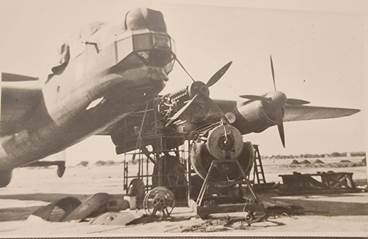
Today I have almost 10,000 hours flying aircraft of all types and if asked which was my favorite wartime aircraft would say without doubt the Lancaster but I'm certain, given more time with the Lincoln, would have become just as attached to this aircraft being a romantic at heart and given a wish, I with my crew, (all alive and in touch), would wish to fly again for a few minutes the Lincoln and her little sister, the Lancaster.
In conclusion, the sincerest tribute I can pay to the Lincoln after having such a tried and tested friend in the Lancaster is to quote 57 squadron motto:-
“Corpus non animum muto”
Translated
“I change my body, not my spirit”
F. M. Jones
August 1974
Round the world
In 1948 and 1949, I had the urge to set up the record for a round-the-world flight in a piston-engined aircraft and had in mind flying a mosquito. I had no money, just the idea, so I wrote to wine and spirit companies asking for financial assistance with the project. One well-known rum company wrote to me, regretting that they could not help me financially, but offering to supply me with enough room to sustain me on the journey. The idea had to be abandoned.
How I Met My Wife, Lucy
It was really an operation which I decided to have in 1948 at the age of 28. A sort of cosmetic job, I suppose. I went to a private nursing home in Blackpool. The matron, I later found out, was a gin drinker. This has nothing to do with the story but it was good business for me, being in the wine and spirit trade.
I was given an injection to put me to sleep before being taken to the operating theatre, when the matron arrived and found that I was still awake, she remarked that I might as well walk to the theatre. At this stage, I began to have some doubts about the establishment.
When we got to the theatre, the doctor said, “Patients are usually asleep when brought up here, never mind, jump on the table and relax”. He then came across and said a thing of beauty is a joy forever. By this time, I was somewhat anxious, in fact I was terrified. Fortunately, I was given an anaesthetic and didn't feel a thing until I woke up.
I came to wondering where I was; this lovely nurse was assuring me that all was well. I left the home that evening, but not before I had made a date with her for the following evening. We went out, and I kissed her with some passion, which caused me a lot of pain since I was still suffering from the operation. We met regularly, and it was a long time before I could do so without being in agony. Sometimes I think I was a martyr, but then I was in love. We were married on 3rd of March 1951. Oh! I forgot to tell you what the operation was. A circumcision!
I Went Back
The urge had been there for many months, but business commitments had delayed the journey. The opportunity came when my friends on holiday in Blackpool asked me to stay with them in Lincoln for a few days. I had just sold my business and accepted their offer with pleasure and when I had been in Lincoln a couple of days, decided to go back. With my fiancée, I travelled a once familiar route stopping at small country railway stations with quaint names, some of them I vaguely remembered. Lost in memories I was no company for my fiancée, but she seemed to understand. I had booked to Firsby but when a voice called out Stickney, I was jolted into action, a hasty exchange of words with the station master through the open window of the carriage confirmed that this was the station I wanted, not Firsby.
On the platform comprehensive instructions and directions were given with a reminder that the last train back was around 17:00 and the quickest way to the main road was via the embankment. I climbed the slope followed by my companion who muttered something about wearing slacks and flat heeled shoes instead of a slim pencil skirt, nylons and high heels. After struggling through the barbed wire fence onto the main road I paused for breath - it is astonishing how four years of business life affects a man's wind. I asked the native for further directions, these were given with the assurance that my destination was not far and only a few minutes’ walk. What a queer conception of distance and time these friendly, courteous country people have for I was still walking over an hour later, but I did not mind, there was a glorious sun, light warm breezes and fields of yellow and green, it was indeed God's country.
The men working in the fields whistled and waved and I waved back happy that such a friendly spirit existed between strangers and then I looked at my companion's tight jumper and shapely nylon covered legs and reflected for a moment on Cowley's description of a woman - “Only one of nature’s agreeable blunders”.
In the distance I could see a landmark and journey's end was near; I was soon at the crossroads in the village of east Kirkby, a very small, quiet village where time seemed of no importance. Down the road I walked to the main gates of the camp and wandered past the deserted guard room, half expecting someone to ask for my identity, but this was 1950 not 1944. On I went past the empty buildings to the squadron offices and stood by the cycle rack looking at the squadron number painted on a hut and the names of targets still on the outer wall of the briefing room, a silent testimony to a glorious past. I was back and with my bomb crew again. Tich, the rear gunner who, just after we arrived at the squadron, was sent with another crew on an operational trip and did not return. Ginger the air-bomber who held a bible in one hand and released a load of bombs with the other. Steady Bill, the mid-upper gunner who loved to drive my old Riley. Don the navigator, so polite, even on ops, when his favourite acid remark to my question was, "My dear Captain we are not lost as you may think but temporarily uncertain of our position over the ground". Dear Don, an ex-schoolmaster, who did not drink or swear, took more drink than he could stand when victory was announced, and took great delight in squeezing the contents of a tube of toothpaste over the floor and on the walls stating to everybody that the bloody war was over at last. Stan the wireless operator who welcomed any excuse to go home to his girl. Sid the cockney flight engineer with a smiling face that was a tonic to everyone, but my one fear was that a high-ranking officer would fly with us one day and there was a ninety percent chance that Sid would address him as ‘Mate’ or ‘Cock’.
There was the engineer leader with more than 2 tours of operations to his credit whose favourite party piece was to recite a poem about one of our allies who was supposed to fly at 50,000 feet with a teeny-weeny bomb, his recitation was always given smoothly despite the emptying of flower vases full of water over his head and the arranging of flowers in his hair.
Many incidents came back as I looked around and saw the empty hangers, the runways hidden by long gras and the remains of the control tower, all a mute reminder of a once active bomber aerodrome. I entered the locked flight office through a small window and walked along the passage looking into the rooms stripped of everything and covered in dust, all was silent but for the occasional rattle of an unfastened window caused by a light wind, my footsteps echoed as I walked looking hopefully for a connection with the past.
I found one in B flight pilots' room, a thin black border put up when we decorated the room years ago. It was dropping in places but there was nobody to care now, even the glamorous pin up girl on the wall had faded as if in sympathy. I left the building by the window and experienced mixed feelings, my eyes were moist, I had been moved by the past and did not want to relinquish my hold. I thought of the men who had left this aerodrome and died that others might live when they had so much to live for. I thought again of Tich, his children, and his widow’s words when she wrote to me recently, "Tich and I had dreams, but it doesn’t do to build castles…because I haven’t met anyone as nice and kind as Tich”. I remembered the day the crew bought a baby set for Tich junior and the squadron motto passed through my mind, "I change my body, not my spirit".
Months before visiting the aerodrome I met many squadron friends, some had changed a little but the spirit that keeps a squadron together was still there fostered by past training, determination, discipline, adversity and friendship, a similar spirit I have yet to experience in 'civilian' life.
RAF Digby - 1951-53
During my stay at Digby as a civilian flying instructor, we used to entertain the public on Open Days with flying displays. We had two favourite acts. The commentator would say that we were fortunate in having an ace pistol shot with us, and that he would display his skill by shooting with a revolver from an aircraft, a Tiger Moth, at balloons. On the airfield, we had a truck with the open end covered in hessian and balloons attached. The Tiger Moth would dive towards the truck, and the ace shot would lean out of the cockpit and fire his revolver. There would be a puff of smoke from the revolver, and a balloon would burst; this would be repeated until all the balloons had burst. What the spectators did not see was the person in the back of the track with a pin, who burst each balloon as the Tiger Moth approached.
Our other act was given a build-up by the commentator that the spectators would be able to see a student being given a solo check and then sent up solo if thought fit. The instructor in the Tiger Moth would taxi out and do a couple of hair-raising circuits and landings; he would then get out of the aircraft and tell the 'student' (an experienced instructor) to go solo. Out of the crowd would rush a little old lady with an umbrella (another instructor in drag), who would go for the Senior Air Force Officer present and create a scene, accusing him of letting her grandson risk his life. She then would dash towards another Tiger Moth standing with its engine running in front of the spectators, beat the pilot over the head with her umbrella and drag him out of the cockpit. She would then jump into the plane and chase after her ‘grandson'. The commentator would pile on the agony with his comments, and the two Tiger Moths would perform some very unorthodox manoeuvres as Grandma chased Grandson!


