

Chapter 6 - It All Happened At Thorney Island
In April 1953, I started a refresher course at RAF South Cerney, flying the Harvard 23, Prentice and Piston Provost. In September 1953, I went to an Advanced Flying School at RAF Swinderby, where I received an above-average rating as a multi-engined pilot. In December 1953, I was posted as a staff pilot to No. 2 Air Navigation School, Thorney Island. The staff pilot's duties were to fly the Varsity twin-engined aircraft for the training of student navigators and to carry out ditching, crash-landing and bailing out drills as required by the staff navigator. The average navigational flight was around 4 hours, with longer overseas flights to Idris, Malta, Gibraltar and Germany.
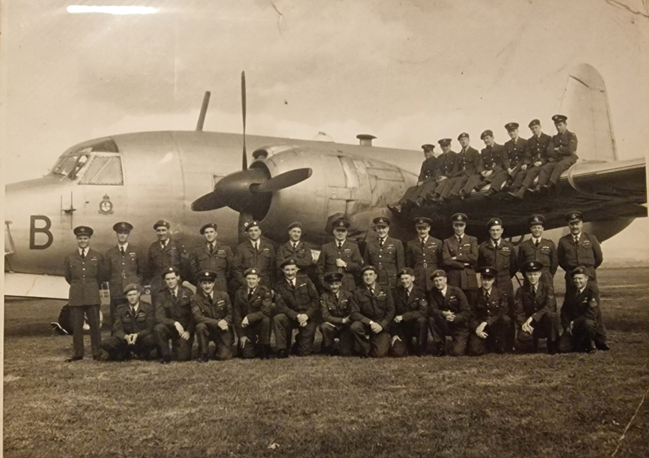
Many incidents occurred during my stay at Thorney Island, until I left in October 1956; I cannot recall these incidents in sequence but present them as I remember. Somebody, I think it was Neville Duke, crash-landed a jet aircraft at Thorney Island. Jack, a Flight Sergeant who already had the Air Force Medal for some outstanding deed before my time, was bringing his Varsity home one day when an engine failed - this was no great hardship because the Varsity flies very well on one-engine; however, just before Jack was due to land, the other engine failed and Jack had to land his Varsity on the mudflats. Later, on a radar approach to Tangmere in very bad weather conditions Jack felt the aircraft shudder, and on inspection after landing, trees were found sticking through the wings. There had been a fault with the radar equipment, nothing to do with Jack! He then rolled his motor car. The last thing I heard of unlucky Jack was that he had been taken off flying duties and put in charge of the Link Trainer (a ground flying simulator).
A new aircraft was introduced to Thorney Island - the Marathon, a 4-engined trainer, 4 small engines, a sort of mini-Lancaster. There had been a fatal accident with a Marathon, and this provides the background to the following incident. In Air Traffic Control one night, the Marathon and Varsity Squadron Commanders were awaiting the return of their respective aircraft: enter a very young Pilot Officer (ground duties) who mentioned that he had never flown in an aircraft and would very much like to do so. The Marathon Squadron Commander said he would be pleased to give the young Pilot Officer a flight in one of his aircraft. With memories of the fatal accident to the Marathon, the officer declined the offer and stated that he would not mind flying in the Varsity, as it was such a reliable aircraft. It came to pass that the Pilot Officer found himself one night at 5000ft standing next to the pilot of a Varsity, Sergeant Pratt, a Lancashire lad. Sergeant Pratt, during the flight, turned to the Pilot Officer and said: “Put your parachute on, both engines are on fire and we are bailing out”. The young man thought it was a big joke, until he saw members of the crew dropping through the escape hatch. The crew bailed out without injury, but the poor Pilot Officer broke his ankle on landing. Both engine fires went out, and the Varsity, crewless, made an almost perfect belly landing.
One night, when I was flying the Varsity, practicing Eureka/BABS approach and landing, a funny thing happened. First, to explain Eureka/BABS briefly. Eureka was the equipment carried in the aircraft to interpret the BABS equipment, which was housed in a small hut or wagon at the far end of the runway. BABS sent a signal down the centre line of the runway, and the navigator would see a signal on a radar tube and would instruct the pilot accordingly - 'Navigator to pilot, turn left 5°; steady, you are on the centre line; right 2°; steady, you are on the centre line'. This particular night, the navigator suddenly announced that he had lost the BABS signal, and could I check with Air Traffic if the equipment was working. This I did, and received the following reply: 'The signal is not being received because a Marathon has just over-run the runway and has knocked the BABS wagon into the sea'. The sequel to the story is told by the staff navigator on board the ill-fated Marathon : 'There was no warning that the Marathon pilot had any problems, but then there was a hell of a bang and all the lights went out; my first instinct was to get out, and I opened the door, and then I thought control yourself, think of the crew. At this moment, 3 shadowy crew members shot through the open door, so I thought f--- the crew, and jumped out after them'.
We always encouraged our airmen to fly. One day, the Flight Sergeant i/c ground crew noticed a Varsity taxiing out. There was a night flying programme, and no aircraft should have been flying. He suddenly realised that one of his airmen was at the controls. A panic call went out, but before anything could be done, the engines of the taxiing aircraft reared into life and the Varsity started a take-off run over the grass and across the runways, and it was soon airborne. The duty officer leapt into another Varsity and went in pursuit and later reported the stolen varsity in flames down in a forest. Regretfully, he was mistaken, because the varsity was on its way to France, where it ran out of fuel and crashed, killing a French family and the airman.
The helicopters were giving a great demonstration, one of them hovering above the sea for the benefit of TV and the news media, when he ran out of fuel and crashed into the sea. I was an Orderly Officer that day and received a signal for the Squadron Leader. It said, ‘Dear Squadron Leader, I understand all your crew now equipped with webbed feet”. I didn't have the heart to give it to him for he was an excellent and well-liked pilot but like everybody he was human and had erred. Another helicopter arrived to lift out the crashed one and he too went into the sea.
What I remember best about Thorny Island is the birth of my second son Barry in Emsworth. There was also a Wing Commander's wife who liked nude bathing parties, mixed of course, but then that is another story outside the scope of this book.
In September 1956, I borrowed a Chipmunk aeroplane and practised aerobatics in preparation for a Battle of Britain display. finished my aerobatic act on the day with a climbing roll from near the ground, too near it seems, for I had to appear before my Commanding Officer, who warmly congratulated me for my aerobatic display, and then apologised for having to reprimand me, as there had been senior RAF officers present during the show and he was covering himself because it was quite clear that I had come below the height limits.
My hobby at this period was 'electronics'. In fact, when at school in my very early teens I had constructed a Baird-type television receiver, using a domestic appliance electric motor and a metal disc - it looked more like a bacon slicer than a television receiver, and was never completed due to lack of funds. Thorney, I built a 'Flying Spot Scanner', from ex government electronic equipment - it had 2 cathode ray tubes, 1 transmitting and the other receiving, both operated from a common time base. What it did was to scan a picture or film slide and reproduce it much larger electronically on a television-type screen and could be switched to give either a positive or negative image. A similar system was used by the TV companies to transmit their films but using a more sophisticated system.
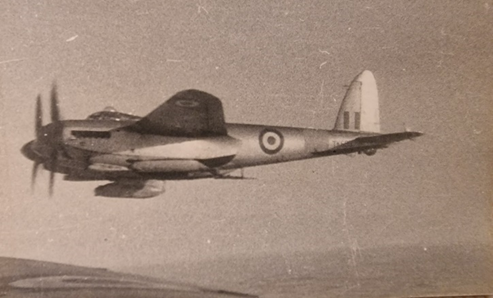
I was also into the 'infra-red', and built equipment for seeing in the dark, using ex-government infra-red tubes. I was helped in this project by a well-known manufacturer of theatrical spotlights, who kindly loaned, and then gave me a powerful spot lamp to assist in my experiments. I left Thorney Island in October 1956, rated as an above average Staff Pilot, and was posted to the Target Towing Flight (TTF) RAF Schleswigland, where I realised my ambition somewhat late, I must admit, to fly the Mosquito, a twin-engined aircraft with a great wartime reputation, in various roles - fighter, bomber, photographic reconnaissance, pathfinder force marker, and meteorological work.
The biggest problem initially was finding married accommodation, there was just no chance of RAF married quarters for me, as the few available were already taken. To be with my family, I had to take hotel accommodation in Schleswig, and this accounted for most of my income until many months later I found a flat way out in the country - it was expensive, but still cheaper than living in the hotel.
Our role at RAF Schleswig was to fly targets for the NATO forces to fire at - this was done over the ranges at Toderdorf on the - Baltic Sea. Now and again, the flak from the ground gunners would burst very close to the aircraft, on the odd occasion it was more dangerous than flying during the war. It was lightly said that when the Germans were firing, force of habit made them aim at the Mosquito rather than the target thousands of yards behind. We did manage to get our revenge. We were asked to supply a Mosquito display for a German tank unit, so we sent our mad (very capable) Flt. Sgt. pilot over to Toderdorf. Some photographs taken at the display showed the Mosquito, on one engine, approaching the tanks below the level of their guns, and officers leaping off the tanks in panic.
We drank well, perhaps not wisely at times, if the story is true. After a fair amount to drink, one chap took his wife home by car, they lived out in the country. When they got home, the wife said: 'You are drunk'. The husband strongly denied this accusation. His wife then said: “when we went to the party tonight, we had a Ford car, and now we have a Mercedes. You must be drunk”.
We had a young jet pilot attached to us to fill in time until he was posted to another unit. He was converted to the Mosquito, some of the handling techniques were different to jet techniques, and sadly he was killed in a crash. I was appointed Effects Officer and had to gather together all his personal belongings in accordance with RAF procedure. There is a procedure for everything in the RAF, rightly so: The island of Sylt was not very far away, about 25 min. flying; if we wanted to obtain certain clothing or equipment, we went to RAF Sylt - another attraction, I think, was the nude bathing at Sylt!
Whenever we visited another RAF Station in Germany, it was incredible the number of people who came to look over the Mosquito. We were the last of the few operating aircraft, which was mainly constructed of wood. At the end of my tour at Schleswigland, the Mosquitos were flown back to England and scrapped. An article in some paper was published, saying that these aircraft were the last of a famous line. It seems that letters came in from all over the world saying that firms were still using the Mosquito for weather checks and other purposes.
Schleswigland, when operated by the Germans, was called Jagel. We were not far from the Danish border, and now and again went to Denmark, where the countryside was very like England. During my time here, I volunteered for a survival course in Bavaria and went to Bad Kohlgrub where the Commanding Officer of the course met us with his leg in plaster - a good start! We were placed in groups of 4 and had 10 days out of the 14 for skiing. The minor accident rate was quite high, with twisted ankles and bruises. 3 days were spent on survival - we were taken out into the wilds by coach and dropped. We lived in the snow-covered forest in parachute and other survival-type shelters. I can just about boil an egg, so I was appointed cook and had to do the best I could with emergency rations. With a modicum of reserve, I reckon I did a reasonable job, perhaps the others were just too tired to complain. Each party of 4 had no money other than 1 DM, which was to make a phone call in a real emergency. The locals were also asked to pursue us, which added to our difficulties.
During the skiing part of the survival course, some of us were gathered at the bottom of a very steep slope, which ended in a sheer drop. The experienced German/Austrian skiers were sliding to a halt in a shower of snow and one of them nearly went over the edge. We were all dressed in black, and in a line; I nudged the person in front of me and said: 'She nearly went arse over tit'. The person turned round: 'What were you saying?' She was the Commanding Officer's wife - how was I to know that she went on the ski runs with the men and dressed in the same outfit we all wore!
German propaganda during the war must have been good - the owners of the flat in which we lived in the basement, he was of limited mentality, but she was a well-educated woman and spoke good English. When we had known them for some time, we were astounded when she asked if it was true that we ate our babies during the war years.
One of our corporals wanted a new hat, so I said I would take him over to Sylt during a training flight. During the return flight, I said I would 'feather' (stop) an engine to practise single-engined flying. This I did, but when the time came to restart it, it wouldn't. I called Schleswig and informed them that I would be making a single-engined approach, and- landing. On the downwind leg, I selected undercarriage down, and only one leg came down; the approach was continued, the decision height to overshoot was 800ft. At this height, the undercarriage indicator lights showed one wheel down and one wheel up. I decided to go round and try again, so I selected undercarriage up and put the aircraft into a shallow dive to pick up speed. Suddenly the aircraft started to yaw (swing) and I noticed that the undercarriage lights were showing one red, one green which meant that one leg was still down. The aircraft was below critical speed and turning, heading for the fuel area on the airfield. I managed to head downwind and crashed on the airfield. For seconds, I must have been unconscious, because when I came round, I was sat, firmly strapped in my seat, in the midst of wreckage, and I remember hearing what sounded like a dripping tap. I tried to move and couldn't, and immediately thought I was paralyzed; As my mind cleared, it all came back. I released the safety harness and realized that the dripping noise was petrol leaking from fractured tanks and pipes. I turned off the fuel Cox at the rear, checked that the Magneto switches were off, and walked out through the front of the wreckage. An airman dashed up to me and said, “Put your arm around me sir”. I said that I was OK and told him to get my passenger, but he was already being rescued. The airman insisted that I put my arm around him, and he said, “You've got to be rescued proper”. He was right, of course, because in my dazed state I might have wandered back into the wreckage, which could have caught fire.
I was laid on a stretcher, covered with a blanket, and distinctly remember my RAF issue watch being taken off my wrist by an American airman.
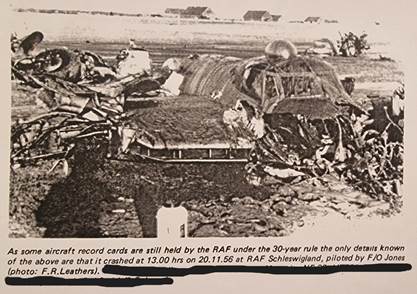
The airman’s story was that he had taken the watch so that he could look after it for me, it was an Omega and worth, I think, about £50. I've got my watch back and what happened to the airmen I do not know. Until I saw a photograph of the accident, I didn't realise how lucky I had been to escape serious injury, there was a slight cut on the head, a cut on the hand, and a sore back. I spent a few days in a German hospital and received treatment which involved standing in a pool of water with underwater jets playing on my back. My passenger, poor chap, was suffering from shock, but we both got over our experience of crashing an airplane at somewhere around 100 mph. It was interesting to note, much later, that the decision height for overshooting the mosquito on one engine had been raised to 1000 ft.
When I came out of hospital, I went to England on a Fire Officers' course, and during the training it was mentioned that aircraft like the Mosquito nearly always caught fire after a crash - I didn't want to make a point, I was just glad to be alive. It was rather strange during the crash; I saw the Mosquito breaking up, but didn't hear anything - probably because light waves travel much faster than sound waves and by the time the sound waves reached me I was unconscious.
Fate was kind to me, but not to others. There was not a lot to do in our small mess, and one night a few of us were having a drink; I was invited out but decided not to go. The Flight Commander and 3 other officers went out for a drive in an almost new Opel car, which crashed and 3 of them were killed. When airborne one day, I received a message over the radio asking me to fly to the German/Russian border to identify an aircraft close to the border. I set heading, and in a few minutes saw a very large aircraft going into a turn; I followed him, wondering if it were Russian, but it turned out to be an American aircraft with passengers suffering from something medical which could be eased by the flight. He probably thought I was a Russian fighter plane.
The flat we lived in was built in a sand and stone pit, the landlord was in the sand and stone business. The medical officer from Schleswigland came out to test the water, which came from a well; he found that it was not clean enough to drink, so we had to get regular supplies of water from RAF Schleswigland in milk churns until Hanas the owner did something about the water. He was quick to do so, because he could see that his well-paying tenants would otherwise have to leave. Hanas did not speak English, but through his wife he explained that his friend, a water diviner and explosives expert, would be along the next day to do something. Hanas was a bit of a character, and we had a strong suspicion that he used to illegally hook up his electricity to the mains.
The friend arrived the following day - it was interesting to note that he was minus two or three fingers. He wandered around the front of the house holding a divining rod in his hands; he seemed to find a suitable spot and started boring. This seemed to go on for hours, but eventually he mopped and produced a box of what appeared to be dynamite sticks. At this stage, I began to have doubts as to the outcome of the operation and retired to the (at this stage) safety of the flat and continued to watch through the window. Hanas, his wife, and the explosives expert were engaged in animated conversation, the explosives expert with one hand at the hole in the ground, and with the other holding a stick of dynamite or similar substance. There was a knock on the door, and Hanas' wife explained that blasting would take place in a few minutes, and would we move the radio, etc. on to the floor. Within seconds, there was a bloody great bang, and the house shook. When I looked through the window, which by some miracle was still in the frame, Hanas and the explosives expert were still alive, albeit covered from head to foot in mud and sand. Hanas' wife explained that the explosives expert wasn't satisfied, and would have to divine, bore holes, and make small explosions; after 2 days, thank God, he struck water.
Life returned to normal, the TTF was disbanded, and RAF Schleswigland was handed back to the Germans. Instead of a normal tour of 2-2.5 years, I had a short one, 1.5 years, posted as a Families Officer to RAF Alhorn in April 1958. This station was running down, and I operated from a very well-appointed bungalow. My duties were administrative, dealing with married quarters and paying the wives of airmen working away from a small unit a few miles away. Towards the end of my time at Alhorn, I heard that flying instructors were wanted for an RAF mission to the German Air Force. My Wing Commander got me a posting to Landsberg, near Munich; my wife and children were given a married quarter at RAF Wahn, near Cologne, and I was sent to England for a quick refresher course at RAF Manby in December 1958. I flew approx. 15 hours in the Piston Provost. In January 1959, I was posted to the RAF Mission. The airfield, called Penzing, was a few miles from Landsberg, and there we flew the Harvard 4B, a version of the aircraft I had flown in America in 1942. The US Air Force had been instructing the Germans before us. Initially we lived in the German Officers' mess, the meals were different, and one Lancashire officer had little to eat for almost a week because he didn't like the food. On Friday, fish and chips were served; he was delighted and called the waiter over and asked for vinegar. ‘Weniger’ in German, means 'smaller', so the waiter took his plate away and returned with half a fish and a few chips, leaving a speechless officer.
Each flight consisted of a German Flight Commander with the rank of Hauptmann (equivalent to Flight Lieutenant) and a RAF Deputy Flight Commander (Flight Lieutenant). The remainder of the flight were RAF officers, German officers and non-commissioned officers. The mixture worked very well, but I felt that the more informal approach of the RAF officers towards the student was better than the very military attitudes of most German instructors. Often the briefing of a student by a German instructor would be given with the student standing at attention and saluting when finished. In my opinion, you cannot teach successfully unless you have a relaxed, but still disciplined, relationship!
The German officers' mess was really a club - one interesting activity left by the Americans was 'Happy Hour', when the drinks in the mess were free for an hour. Bingo was also played, with numbers called in English and German.
Landsberg am Lech
Landsberg is a town on the river Lech, not unlike Tavistock, Devon, in some ways. I lived in the mess at Penzing for a short time and then brought my family down and we lived in the hotel Goggl in Landsberg until married quarters were ready in the Kaserne (barracks) just out of the town. The manager of the hotel committed suicide; reasons unknown to us. The Kaserne was originally a barracks but had been converted to large flats. These fiats were fully furnished and heated from the basement which looked like the engine room of a ship. Drink was cheap, from memory a bottle of whisky was about 10/- (50p) and a bottle of gin about 8/- (40p). We used to have parties and entertain around 20 people at a time, this is mentioned just to give an idea of the size of the flats. Our duty-free drink was supplied by the NAAFI in the north of Germany where there were established British Service stations. The supplies were distributed by our wives when a delivery was made to Landsberg Kaserne.
We also had the use of the American PX in Augsberg and Munich. The PX was really a large store selling all goods and had cafe facilities. The Kaserne in Landsberg, in addition to the RAF, had a Panzer (tank) unit and every morning the German soldiers would march past our flats singing in German, 'It's a long way to Tipperary'. It's a fact the Germans were taught to sing marching songs, and they did this very well. The Germans we found were great family men and loved children: they used to give children rides in the tanks. Many of the soldiers were National Service men for 1.5- to 2 years and when they finished their time they would dress up and celebrate leaving the service. There was one American officer and his family living in the flats and his service provided him with a 16mm projector and a full-length film every week. We did not have such luxury - but in time we did build a first-class cinema and had a duty roster of officers to show the films. In the bottom flat of my block lived an American soldier who was a cook and when we met on the stairs he would say, "Hi, how would you like a pizza pie?" and I used to say, "Hi, what kind of pie?" He would mutter something and disappear into his flat. At this point I must say that I genuinely thought he was offering a piece of pie, and I didn't know he was a cook. This inane conversation went on several times. One night in our upstairs flat my wife said to me, "The American downstairs has a band in his flat." "Don't be silly," said I. "Go down and find out," she said. I knocked timidly on the door of the downstairs flat where it was quiet and the American airman opened the door, looked at me and said: "You're the English guy from upstairs." I agreed and very apologetically said "My wife seems to think you have a band in your flat".
'Sure thing" he said. "Come in and have a drink."
I went in and there was an eight-piece band resting between numbers. It was a celebration of something. I went into the kitchen and the airman's wife said, "Hi, you the English guy from upstairs?" I agreed. She said "How'd you like a pizza pie.? " I thought here we go again but she produced this lovely pie and then the truth dawned. I ate half the pie which was delicious. She said, "Go ahead, finish it." So I did and went back to the party. Eventually my host got round to me and said, "OK, English guy, you gotta taste my speciality pizza pie. He went away and came back seething. He said: "Some goddamned bastard has eaten all the pizza pie!" My downstairs neighbour joined us in giving a party and one of the novelties was a cut-out of a couple in old-fashioned bathing costumes, the sort of thing you see at the seaside. We photographed the guests with their heads on top of the bathing costumes. I made a capacity operated cigarette dispenser which displayed one cigarette and a sign which said, 'Please help yourself'. When the hand approached the cigarette and was quite near, an electro-magnet made the cigarette disappear before the hand could touch it. Fasching is a great time in Bavaria. It is carnival time and starts on the eleventh day of the eleventh month and continues until Lent, the high spot towards the end of the period is Rosen Montag. During Fasching the skiers dress up in fancy costumes, baby doll nightwear etc. One skier I photographed in movie came down the ski slopes dressed in a night dress and with a pram.
Another highlight is the Oktoberfest held in Munich. Beer tents are set up and the natives drink well but often not wisely and it is quite common for the drunks to be laid out so that they can sleep it off. The prison at Landsberg held Adolf Hitler at one time during his political career. As a professional airman I felt it rather sad that the German pilots were not allowed to wear their decorations and campaign medals - they only did their duty toward their fatherland. It was interesting to note that German officers of equal rank did not address each other by Christian names unless the one who was senior, perhaps by weeks, said it was alright to do so. When we had a party in the mess, we would sing our war songs and ask the Germans to sing theirs but they never would. I felt sometimes that they would never understand our somewhat carefree approach to life. I would think that most people have seen the film 'Those Magnificent Men In Their Flying Machines' and I cannot help but lightheartedly identify the Germans with the Spiked-helmeted German officer in the film.
On the Harvard aircraft which we were flying possibly to cut out Traffic Control and other radio transmissions by pressing a mute switch so that one could continue giving instructions to the student without interruption from outside transmissions. It is human to err. One of our best instructors was coming into land and forgot to put his undercarriage down. He was so engrossed in talking to his student that he could not hear Air Traffic Control telling him that his wheels were up, and he did not see the red flares that were fired at him. He did a beautiful landing on his belly, still talking to his student.
A Harvard landed and was moving along the runway when the pilot of another Harvard coming into land decided to overshoot because he was too close to the aircraft on the ground. He overshot but was too low and hit the other aircraft decapitating the RAF instructor and badly injuring the student. The aircraft was going round in circles until someone jumped onto the aircraft and stopped the engine. Some of the instructors were converted from the Harvard to the Fouga Magister, a jet-engined aircraft with a butterfly tail. One day a German instructor and student were practising spins and recovery (the idea being that should the aircraft inadvertently go into a spin, the student would know the correct recovery procedure). The deliberate spin was started at 17000ft. and the recovery had to be made at 15000 ft., if not, the good book said that the aircraft had to be abandoned. On this day the recovery from the spin was not made by 15000 ft. so the instructor, having told the student to abandon, leapt out. When he left, the aircraft came out of the spin due to the change in the centre of gravity and the student who had not been solo decided to stay in the aircraft and saw his instructor floating gracefully towards the ground. He then flew the aircraft home and landed it without trouble. Not bad for a first solo!
Still at Landsberg
I had a letter from the Inland Revenue, but did not bother to open it for several weeks. When I did, I found that they owed me over £400 and would be pleased to send it to me if I would contact them. I was a Flying Officer at this time, and my neighbour, a Flight Lieutenant, knew that I was going to buy a new car; he constantly advised me, in view of my financial situation to purchase a small cheap French car. He owned a Mercedes 180 diesel. I did not want to tell him that I had already, with my income tax windfall, ordered a new Mercedes 190 diesel with Blaupunkt radio. I had ordered a Citroen, but there were problems in obtaining it in time to meet the import requirement of owning a car 12 months to avoid paying import duty, so my agreement with the Citroen dealer was cancelled. I went to Stuttgart, home of the Mercedes factory, and had words with the Sales manager. There was a very long waiting list for Mercedes cars. I explained that time was of the essence, so he remarked that a couple of bottles of gin might ease the situation. I told him I wanted graphite grey, and he said, "O.K. delivery in a month suitable?" Proudly, a month later, I drove my new car with its Blaupunkt radio to the Landsberg kaserne and parked it outside the flats. The next morning, the radio aerial had been broken off - jealousy? Our cars had to be parked outside the flats, and several aerials had been broken off. I designed a system using an automatic camera (taken from a World War II German fighter aircraft) and electronic equipment to film anyone touching an aerial, but regretfully, the only pictures I got were of the Commanding Officer when I asked him to go through the motions of breaking the aerial on my car for test purposes.
During my time with the German Air Force, I introduced a modification to the RAF flying helmet. With German Air Force equipment, it was not possible to wear the protective (bone-dome) helmet, as earphones and a boom microphone were the standard equipment. I modified the RAF equipment with a miniature Japanese transformer so that it would be possible to match the German equipment and use the RAF helmet and bone-dome.
The German Air Force, when some of their instructors had completed 500 hr. flying, had a parade and presented these instructors with a book. The RAF pilots did not qualify for this presentation, but at 1000 hr. instruction RAF and German Air Force qualified, and were presented with an engraved plated cup.
One of the RAF officers was married to a German woman, who complained to the Officer commanding the RAF Mission that my youngest son was having a competition with another child to see who could pee the highest (they were both sat up in a tree), so I had to go for interview and it was all the Officer Commanding could do to keep a straight face as he tried to describe the nature of the complaint. She was well known for trouble-making -perhaps we should have gone to the Race Relations Board.
Some of us were posted to Mengen in the Black Forest, not to make cuckoo clocks, but to teach German students to fly. By this time, I had also purchased a caravan, so for a while I stayed at a place called Sigmaringen on the banks of the Blue Danube river. I don't know where Strauss was when he composed the Blue Danube; it was brown and dirty where we were and one of our children was very nearly drowned in it.
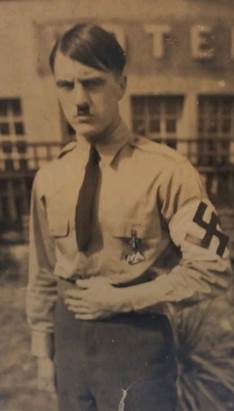
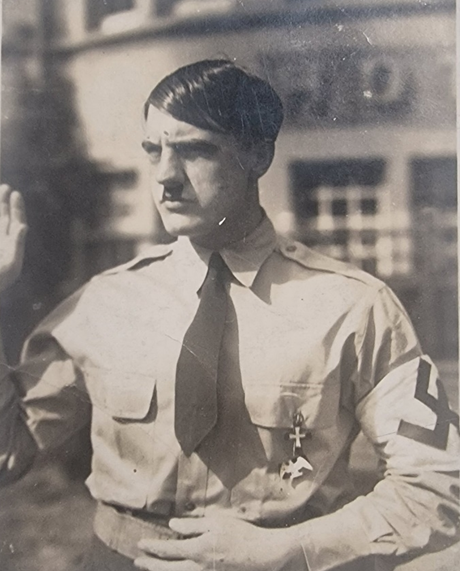
A few of us were living in a hotel near Mengen, and after flying we would have a meal and a few drinks. One of my party tricks was an impersonation of Adolf Hitler, and I was persuaded to go to a fancy dress ball as the Fuhrer - somewhat reluctantly, since doing an impersonation in wartime England was one thing, but in Germany... After a few drinks, I put on the makeup and took the precaution of carrying a cane under my jacket. I was then dared to go on to the floor, which I did. A huge German came over, and said with menace in his voice "Adolf Hitler?" "Nein, nein", I answered hastily, pulling out the cane from under my coat 'Charlie Chaplin", and shuffled off to my friends.
I regret to say that after flying we did not have much to do other than have a meal in the hotel, have a few beers, and go to bed. I went up to my room one night, switched on the light, and saw a beautiful blonde in my bed. I apologised, closed the door and checked the room number. It was mine, so I thought the management must have booked someone into my room by mistake; I realised that I must point this out to the girl and suggest that she make other arrangements, as I was tired. I opened the door, switched on the light, and said "Excuse me, Fraulein, this is my room; I am tired and would like you to move". There was no answer; I tried again, still no answer. I pulled back the bed clothes - there was a hairdresser's head on a pole, which my friends thought was a great joke.
We went one night for a meal to a very high-class hotel; after the main course I thought I would order my sweet in German, so said to the immaculately dressed waiter "Ein Aschenbecher mit Sahne, bitte”. He nodded, unperturbed, and returned with a clean ashtray filled with cream. I thought I had ordered "Eisbrecher mit Sahne - an ice-cream with cream. I thought I glimpsed a faint smile on the waiter's face.
Whilst we were at Mengen, an advert appeared in the local paper saying that 2 RAF officers wanted to meet 2 German girls for fun and games - that was not the exact wording, but that was what it meant. The 2 officers concerned had not in fact put in such an advert, it had been done by "friends". People can be quite malicious unintentionally; my wife received, a letter in broken English from a girl saying that I had given her a child and what was I going to do about it. It turned out to be a sick joke by the people I worked with, who thought it very funny; I did not, nor did my wife, but fortunately she realised that it was a sick joke and accepted the apologies of those responsible.
There was often cloud over the Black Forest, but one lovely day with the sun shining Major (name omitted for privacy) from Landsberg was doing some 60-2 flying (instructor's practice -flying), and he made his way over the Black Forest when he saw what he thought was a Harvard aircraft going into cloud. Being a keen and disciplined officer, he pursued the aircraft and came very close to me. Aircraft, for some reason best known to the German Air Force, were supposed never to fly into cloud. I kept waving him away, trying to tell him by radio that I was giving instruction, and would he keep out of the way, but he was not on the same frequency. Eventually, he "went away, but on return to base I was shattered to find that he had stated that I had gone into cloud. I appeared before the Major in charge of flying and said that I wished to report Major for dangerous flying, unauthorised formation flying and interference with my instruction, and that I had not in fact been flying in cloud, although near it. I was called before the Major later and told that no charges were to be pressed.
On another occasion, the RAF were told that if they did not get in more flying hours in a certain period, they would not be able to go home to their families in Landsberg but would have to spend the weekend making up the hours. This announcement went down like a lead balloon. An Irish instructor, aptly called Paddy, exclaimed: "O.K., Karl, you try that, and we will all go sick and burn the bloody aircraft". Karl went white and asked that no one leave the room. He went and phoned the German Commanding Officer at Landsberg, stating that the RAF were going to go sick and burn all the aircraft - the Fission Commander and the German Commander were flown out to quell the "riot". In fairness, the German Commander did see the funny side of the situation, but to many Germans, things that were said or written were accepted as fact.
It was the practice to have either a German or an RAF officer as duty officer of the day, such duties being published in orders. One day, both a German and an RAF officer were posted as duty officer, obviously an error, but the German Flight Commander would not query it because it was an order. The Deputy Flight Commander, RAF, said he would query it, so with great reluctance, the German Flight Commander went to the Major who, after long consideration, said that it must be a mistake since it was not usual to have two officers doing the same duty.
A Harvard, with a German and an RAF pilot flying, were in collision with a Fonga, the German pilot of the Fonga was killed, and both pilots in the Harvard bailed out, one badly burned and the other landing on top of a hospital, where he was treated for shock.
The RAF Personnel at Landsberg came under an American evacuation scheme, and the Americans thought it was a good idea to send some of their drivers to Landsberg to give the English wives driving instruction on their husbands' cars. I had an Opel Kapitan, which my wife managed to back into a tree at full throttle. Another wife extensively damaged her husband's new Mercedes. The American drivers were not trained instructors and must have found the situation difficult.
Towards the end of my time with the RAF Mission, I had an interesting flight to Bad Kohlgrub (the survival school) and took a movie film of survivors who had made a huge SOS in the snow and fired off red lights when they saw us approaching.
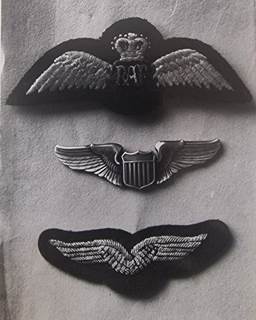
Before leaving the Germans to take over all the training of their Air Force students, we were presented with the German Air Force pilots' wings, a picture of Landsberg-am-Lech and a very nice letter of thanks for our services from the Air Force authorities.
We got on extremely well with the Germans, Civilian and military. Once, when travelling with the family, I stopped and, asked a German for directions through a large city. He started to give me directions, then said "Please wait, I will get my car, and you must follow me". He spent half an hour driving through the city; when he stopped and I thanked him for his kindness, he said "It was nothing, I was a prisoner of war in England; have a good journey".
On another occasion, I was in a hurry to see someone in Munich and parked my car in a "no parking" area outside an office. I was there only a few minutes, but when I came out there was a parking ticket on the windscreen. It was necessary to go to the Police Station to pay the fine, although I suppose I could have sent it by post. I had no idea where the station was, so stopped a pedestrian; when I asked if he spoke English, he enquired in perfect English what my problem was. When I explained about the parking ticket, he became very annoyed, saying he was the director of a Munich bank and knew the chief of Police; I was a visitor to his beautiful city, and he would attend to the matter - I heard no more.
Auf Wiedersehen Germany
After a very pleasant stay of over 6 years in Germany, it was back to England for a refresher course in flying at RAF Manby, from April-June 1963, where I again flew the Varsity aircraft.
In June 1963, I went to the Air Electronics School at Topcliffe, where Air Electronics Officers (commissioned) and Air Electronics Operators (non-commissioned) were being trained. As a staff pilot, my duties were to fly the aircraft so that the students could practise their art (communications, etc.) and, at the request of the staff aircrew, institute emergency procedures such as ditching or abandoning the aircraft.
All practice emergency calls from the pilot were preceded by “This is a practice, repeat practice". On one occasion, I called out "this is a practice, repeat practice; put on parachutes, acknowledge". The crew acknowledged and the staff aircrew member who had been down to the toilet was horrified to see his student with the escape hatch open, on his way down the short ladder ready to jump out of the aircraft. He hauled the student back in and closed the hatch. The bewildered student had thought it had been an order to leave the aircraft and almost collapsed when the staff member pointed out that he had forgotten to put on his parachute anyway. RAF Topcliffe was near Thirsk in Yorkshire, and we had a 'hiring' at Carlton Minniot, a village on the way to Thirsk. If RAF houses were not available, it was possible with official approval to rent a house within reasonable distance of the station.) We had a very nice bungalow, with a neighbour who was quite a character. His name was Jack, and that information must suffice. He was a wealthy retired farmer and a poacher of some repute - his relatives' deep freeze was always full of fish and game. Jack was a very friendly man, and when I tactfully suggested that if he was not careful, he could be in trouble with the law, he just laughed and said that the local law came with him when he went poaching.
Our training flights took us to Germany, Ireland, Malta and Gibraltar; in 1964, I was approaching to land at Gibraltar with the Wing Commander on board, when one engine failed, and we were stuck in Gib for several days until the engine was repaired. We did not have as many incidents or accidents as at Thorney Island, but one night a staff pilot was being checked out on a single-engined overshoot when something went wrong, and both instructor and staff pilot were killed. The service doctor was to have flown with them, but by a stroke of fate at the last minute he was delayed and had to fly with someone else.
Doc was also a character; he was a Squadron Leader and did everything he could to keep his air crew flying. He would often say “when you have finished flying, you had better come round to the private surgery". This was his house, and here you would be given a half glass of neat whisky to kill the germs. His posting to the Far East came through, and over a half glass of whisky one night at the private surgery, he confessed to me that he had about 400ft of black and white pornographic movie film which he did not want to be caught with when he went through customs. Knowing that 8 mm movie film was one of my hobbies, he asked if I would take it off his hands, at no cost. I did, warning Lucy that I would be running the film to see if it should be destroyed. What a farce! The films must have been made when movies first came out - the ladies rolling down their stockings would not have offended Mary Whitehouse. I spliced some of the film in my home movies to give the audience a laugh.
The Station Commander had the bright idea that it would be good to have someone to teach archery, and one night in the mess, in spite of my protests, he made me Robin Hood. I managed to get a course at Lilleshall, and we ran a very successful family club at Topcliffe. We constructed an indoor range in one of the hangars and competed in indoor and outdoor events. On the course at Lilleshall, we finished the training with a display of archery and as a finale, appealed to the large audience for a volunteer to sit with an apple on his or her head so that one of our team could try to shoot the apple with a powerful crossbow, the bolt of which could penetrate several inches of oak. We pointed out that this could be extremely dangerous as the crossbowman had not really yet mastered the art. A huge case with the crossbow was produced, and the deadly weapon exposed to the crowd. It was also suggested that the volunteer should be blindfolded in case his or her nerve failed. All this garbage was delivered in serious vein, and our stooge, posted in the audience, was pushed out of the way by several genuine volunteers, so we had to select one. We blindfolded him, then produced a small plastic crossbow with a sucker on the end of a stick. Our crossbowman, a few inches behind the volunteer, fired the deadly weapon, which stuck on the apple. How gullible can you be!
A pleasant memory of Topcliffe is our dog. He was owned by a service family who were posted abroad. He was a black standard poodle and a bit of a rake; he was often missing before we took him over. He became one of the family and would stand and wait at the window a few minutes before the bus brought the kids home from school. On the RAF station at Topcliffe, he had been used to the cars stopping for him, but one day he dashed out of the house chasing a cat across the road and was killed. We and the kids were broken-hearted to lose him.
I was in charge of the tea swindle, and with the profits, everyone on the flight on posting received an engraved tankard.
During my stay at Topcliffe, my father collapsed when driving his car and died in hospital at Blackpool before we were able to get there. After the funeral, I returned to RAF Topcliffe. I was still upset by my father's death, and shortly afterwards, coming into land one night called three greens, which meant that three green lights were showing, indicating that the undercarriage was down. My navigator said, “you haven't selected undercarriage down skipper”. He was right. I could have landed wheels up!


