Avro Lancaster Bomber
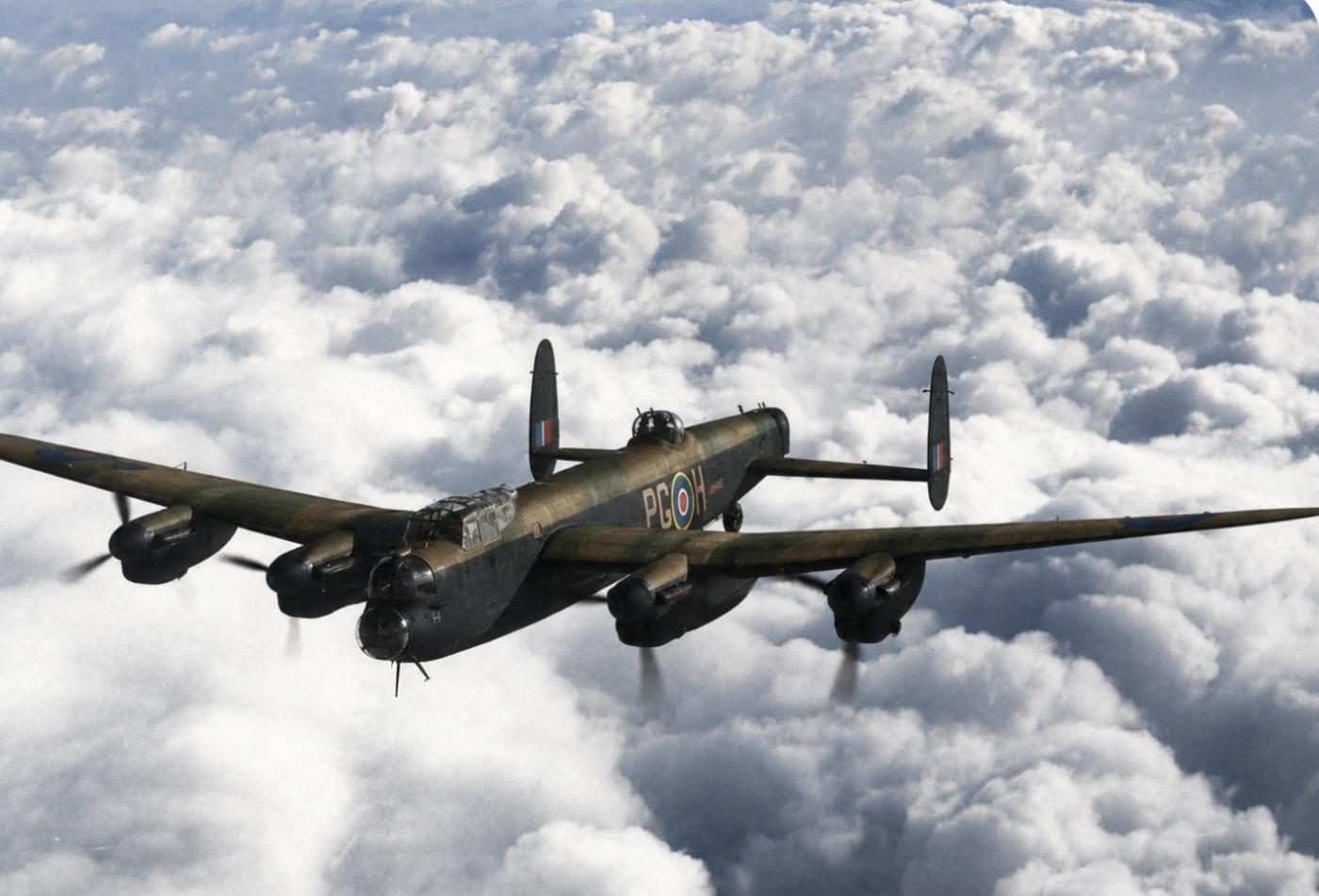
The Avro Lancaster became one of the most famous and respected aircraft of the Second World War. It was a machine that combined tremendous destructive power with remarkable reliability, earning a legendary reputation among the crews who flew it and the civilians who watched huge formations of bombers crossing the night skies over Britain and Europe.
The aircraft was designed by A.V. Roe and Company, better known as Avro. The chief designer was Roy Chadwick, one of Britain’s finest aviation engineers. Chadwick had already designed several successful aircraft, but this bomber became his masterpiece.
Its origins actually came from failure. In the late 1930s the British Air Ministry requested a modern twin-engined bomber and Avro produced the Manchester. Although promising at first, the Manchester suffered badly from unreliable Rolls-Royce Vulture engines. Rather than abandon the design, Chadwick transformed the aircraft into a four-engined bomber powered by dependable Rolls-Royce Merlin engines. The improvement was dramatic. The new aircraft first flew in January 1941 and immediately showed outstanding potential.
It quickly became the backbone of Royal Air Force Bomber Command. Crews respected it for its stability, long range and ability to carry huge bomb loads. Ground crews also appreciated how straightforward it was to maintain compared with some other heavy bombers of the period.
One of its greatest strengths was the long unobstructed bomb bay, which allowed it to carry exceptionally large weapons. A standard operational bomb load was around 14,000 pounds, though it could carry far more on shorter missions. Later in the war it became capable of carrying the massive 12,000-pound Tallboy and the 22,000-pound Grand Slam earthquake bombs designed by Barnes Wallis. These were the heaviest conventional bombs used during the war.
The bomber also became famous for the Dambusters raid of May 1943. Modified aircraft from No. 617 Squadron RAFcarried Barnes Wallis’s bouncing bombs to attack German dams in the Ruhr Valley. Flying at extremely low altitude at night over enemy territory required extraordinary skill and courage, and the operation became one of the most celebrated missions of the war.
A normal crew consisted of seven men. The pilot controlled the aircraft, while beside him sat the flight engineer who monitored the engines and fuel systems. The navigator guided the crew using maps, radio aids and calculations often performed in darkness and under enemy attack. The bomb aimer lay in the nose and directed the aircraft onto the target before releasing the bombs. The wireless operator handled radio communications. The mid-upper gunner operated the dorsal turret, while the rear gunner defended the aircraft from the tail turret, often considered the most dangerous position onboard.
Bomber Command crews faced terrible odds. Missions over Germany exposed them to anti-aircraft fire, searchlights, poor weather and attacks by German night fighters. Casualty rates were extremely high, yet crews developed enormous confidence in their aircraft and believed it offered them the best chance of survival.
Power came from four Rolls-Royce Merlin engines, among the finest aero engines ever produced. These gave the bomber a top speed of about 280 miles per hour and a cruising speed near 200 miles per hour. Operational range was around 2,500 miles depending on bomb load and fuel carried, allowing attacks deep inside Germany and occupied Europe.
The aircraft itself was enormous, with a wingspan of 102 feet and a fully loaded weight exceeding 68,000 pounds. One interesting feature was its landing gear. It used exceptionally large tyres which were often described as the biggest fitted to any operational aircraft of the time. The huge wheels helped support the bomber’s immense weight on muddy wartime airfields.
Defensive armament usually consisted of eight .303 Browning machine guns mounted in nose, dorsal and tail turrets. Even so, enemy fighters remained a major danger, particularly when attacking from below where defensive coverage was weaker.
A total of 7,377 were built. Most came from Avro factories in Britain, though production was also shared with Metropolitan-Vickers, Armstrong Whitworth and Vickers-Armstrongs. Canada also produced many through Victory Aircraft for the Royal Canadian Air Force.
These bombers carried out raids against German cities, factories, railways, submarine bases and military targets throughout the war. One of the most famous achievements came in 1944 when aircraft carrying Tallboy bombs sank the German battleship German battleship Tirpitz in Norway.
Conditions inside were cramped, noisy and freezing cold. Crews wore heavy electrically heated suits and had little room to move around. Despite the hardships, many airmen became deeply attached to their aircraft, often decorating them with names and nose art.
After the war the type remained in service for several years before newer bombers replaced it. A handful survive today, and the sound of their four Merlin engines continues to attract huge crowds at air displays.
More than simply a bomber, it became a symbol of Britain’s determination, engineering skill and sacrifice during the Second World War. Even decades later it remains one of the most admired military aircraft ever built.