Flakvierling 38
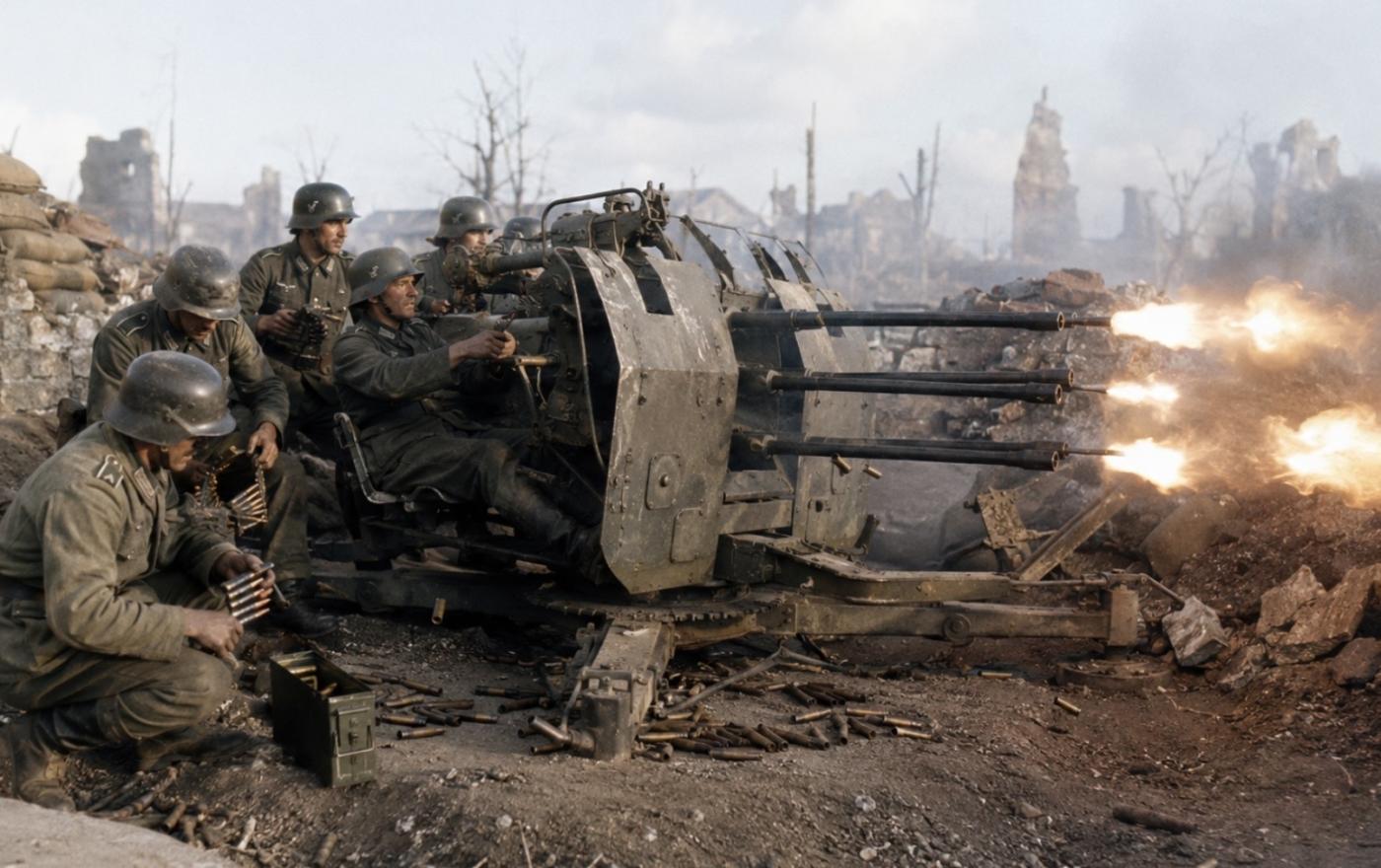
The 2 cm Flakvierling 38 was one of the most recognisable German light anti-aircraft weapons of the Second World War. Its name literally meant “four-barrel aircraft defence cannon,” and that description was accurate: it was a quadruple mounting carrying four 20 mm Flak 38 automatic cannon arranged in a compact square cluster. Although designed to defend troops, airfields, ships, bridges, trains, supply columns and armoured formations from low-flying aircraft, it quickly gained a second and feared role as a direct-fire weapon against infantry, soft-skinned vehicles, lightly armoured targets and battlefield positions.
The gun appeared in 1940, at a time when the Germans were becoming increasingly aware that a single 20 mm cannon did not throw enough metal into the air against fast, low-level aircraft. Earlier German 20 mm weapons such as the Flak 30 had been useful, but their rate of fire was limited and their small magazines meant constant reloading. The improved Flak 38, developed from the earlier 20 mm line, increased the rate of fire and became the basis for the four-barrel mounting. By combining four cannon together, the designers produced a system that could fill the sky with a dense cone of fire during the few seconds in which an attacking aircraft was vulnerable.
The 2 cm Flakvierling 38 is generally credited to Mauser, with production also associated with Rheinmetall and Ostmarkwerk, among other German-controlled industrial facilities. Its development sat within a wider German armaments network that had grown out of Rheinmetall and Solothurn work on powerful 20 mm cannon before the war. The gun fired the 20 x 138 mm B cartridge, often called the “Long Solothurn,” a long, powerful 20 mm round that gave it a high muzzle velocity and made it more effective than many lighter 20 mm aircraft-type cannon cartridges. The basic Flak 38 cannon had a barrel length of about 1.3 metres, or 65 calibres, and the complete quadruple mounting was a substantial piece of equipment rather than a simple light machine gun.
About 3,768 mountings are commonly listed as having been produced between 1940 and 1945. This figure normally refers to the quadruple assembly itself, not to every single 20 mm Flak 38 cannon of all types. Far more single 20 mm guns existed, but the four-gun version was more complex, more expensive and heavier. It was used by the Luftwaffe, the Heer, the Waffen-SS and the Kriegsmarine, appearing on fixed ground positions, airfield defences, flak towers, trains, half-tracks, ships, ferries and armoured vehicles. One of its best-known self-propelled uses was on the Flakpanzer IV Wirbelwind, which mounted the four cannon in an open-topped rotating turret on a Panzer IV chassis.
A normal crew was usually around eight men. This could vary depending on service, mounting and tactical situation, but a full detachment typically included a commander, gunner, sight operator or layer, loaders, ammunition handlers and range-finding personnel. The gunner sat behind the weapon and controlled traverse and elevation by handwheels. The assembly could traverse through 360 degrees and elevate steeply for anti-aircraft work, with enough depression for use against ground targets. The four cannon were fired by foot pedals, each pedal firing a diagonally opposed pair of barrels. This arrangement helped balance the recoil and allowed controlled bursts instead of simply emptying all four guns at once.
Each cannon was fed by a 20-round box magazine. This was one of the weapon’s great limitations. In theory, the four guns together could fire at a very high cyclic rate, often quoted at about 1,400 rounds per minute and sometimes higher depending on how the rate is calculated. In practical use, the rate was closer to about 800 rounds per minute, because magazines had to be changed constantly and barrels heated quickly. At full practical fire, a magazine could be emptied in only a few seconds. This meant the loaders had to work with speed and rhythm, changing magazines almost continuously while the gunner tracked the target.
The ammunition included high-explosive shells, high-explosive tracer, incendiary types, armour-piercing rounds and armour-piercing tracer. For anti-aircraft use, high-explosive and tracer ammunition helped the crew see and correct the stream of fire. Against ground targets, armour-piercing ammunition could damage light vehicles, trucks, armoured cars, half-tracks, aircraft on the ground and the thinner armour of some light tanks or tank sides at short range. Against infantry, the effect of four rapid-firing 20 mm cannon was devastating. The shells could smash masonry, cut through timber, tear apart soft vehicles and shower positions with fragments. This is why Allied soldiers often regarded the weapon as more than just an anti-aircraft gun; when lowered for direct fire, it became a brutal battlefield suppressive weapon.
The effective anti-aircraft ceiling is often given as roughly 2,200 metres, although maximum ballistic range was greater and some sources give different vertical figures depending on whether they mean effective ceiling, maximum vertical reach or theoretical range. Horizontally, the 20 mm shell could travel several kilometres, with maximum ground range often placed around 4,800 to 5,000 metres. In real combat, however, effectiveness depended far more on target speed, angle, visibility, crew skill, sights and ammunition supply than on theoretical range. Against aircraft, the weapon was most dangerous at low altitude and short to medium distance, especially during strafing or dive-bombing attacks when the pilot had to fly into the engagement zone.
Its accuracy was not measured in the same way as a rifle or precision cannon. This was a volume-of-fire system. The purpose was to put a dense pattern of explosive and tracer shells into the path of a moving aircraft. The gunner had to lead the target, track it smoothly and fire in controlled bursts. Optical sights and later sighting aids helped, but success still relied heavily on training and judgement. Its real strength was that four cannon firing together increased the chance of a hit during the very short window available against a fast aircraft. A single 20 mm hit could damage an aircraft; several hits could destroy it or force it to break off its attack.
The weapon was heavy for a light anti-aircraft gun. With its trailer and mounting, it weighed roughly one and a half tonnes. It could be towed on a special trailer, brought into position and levelled on its base. The triangular platform gave stability and allowed all-round fire. Armour shields were often fitted to protect the crew from small-arms fire and fragments, although these shields did not make them safe from artillery, tank guns or heavy machine-gun fire. In fixed positions, the gun could be dug in or protected with sandbags. On vehicles, it provided mobile air defence for armoured and motorised formations, but the open crew remained vulnerable.
German forces used the quadruple 20 mm gun wherever low-level air attack was a serious threat. It defended airfields against strafing, guarded supply routes, covered bridges and river crossings, protected armoured columns and reinforced strongpoints. On the Eastern Front, in North Africa, in Italy and in Western Europe, it was frequently used against ground targets when aircraft were absent. This ground role was not an accident or a rare emergency use. Crews understood that the weapon’s high rate of fire made it effective for stopping infantry assaults, breaking up ambushes, sweeping tree lines and roads, and destroying unarmoured vehicles. In urban fighting, a burst from the four barrels could chew through windows, roofs, light walls and barricades.
The Kriegsmarine also used 20 mm quadruple mountings extensively on ships and smaller naval craft. Naval versions differed in details from army mountings, especially where ship movement and deck installation required special arrangements. German ships, including destroyers, minesweepers, armed trawlers, auxiliary vessels and even some U-boats, carried 20 mm weapons to improve short-range defence against aircraft. As Allied air power increased, especially from 1943 onward, German light anti-aircraft armament was repeatedly strengthened, though 20 mm weapons became less satisfactory against tougher, faster aircraft.
The gun’s main weaknesses were built into the concept. Its 20 mm shells were fast and useful, but they lacked the destructive power and reach of heavier 37 mm and 40 mm anti-aircraft guns. By the middle and later years of the war, Allied aircraft were faster, better armoured and often attacked in greater numbers. A 20 mm gun needed hits, sometimes many hits, to bring down a robust aircraft. The small 20-round magazines also limited sustained fire. The crew had to expose themselves while feeding the guns, and the weapon consumed ammunition at a tremendous rate. A well-supplied detachment could create a frightening wall of fire, but without a steady flow of magazines its power quickly dropped.
Despite those weaknesses, the 2 cm Flakvierling 38 was successful within its intended low-altitude role. It was mechanically straightforward, compact for a four-gun mounting, and adaptable to many platforms. It could be towed, fixed in position, installed on ships or mounted on vehicles. Its psychological effect was considerable. The sound of four 20 mm cannon firing together was distinctive, and the stream of tracer could be intimidating to pilots and infantry alike. For ground troops caught in the open, the weapon was especially dangerous because it combined automatic fire with explosive shells, giving it far more destructive effect than ordinary machine-gun fire.
By 1944 and 1945, the system was no longer a complete answer to Allied air superiority, but it remained useful because Germany needed every available weapon to defend against fighter-bombers and low-level attacks. It was often seen around important roads, bridges, railheads, airfields and command areas. In the final fighting, it was just as likely to be fired horizontally at advancing infantry or vehicles as upward at aircraft. This dual use is one reason the weapon has remained so well known. It symbolised the German attempt to defend against air attack with dense automatic fire, but it also became one of the most feared close-range ground weapons in the German arsenal.
The 2 cm Flakvierling 38 was therefore not simply four small cannon bolted together. It was a practical answer to a real tactical problem: how to hit low-flying aircraft during a brief engagement. Its designers solved that problem by multiplying the number of barrels and accepting the penalties of weight, ammunition consumption and constant reloading. Around 3,768 were built, and they served on nearly every front used by German forces. Firing powerful 20 x 138 mm B ammunition, crewed by about eight men, and capable of throwing hundreds of explosive shells per minute, it was one of the most formidable light anti-aircraft weapons of the war and one of the most dangerous when turned against ground targets.