On this day in military history…
On 16 May 1948, Egyptian forces were already moving through Gaza as part of the opening Arab intervention in the first Arab-Israeli War. The wider war had begun immediately after the declaration of the State of Israel on 14 May, when forces from Egypt, Transjordan, Syria, Iraq and Lebanon entered the former British Mandate of Palestine. Egypt’s advance came from Sinai into the southern coastal strip, with Gaza becoming the main gateway for the Egyptian army’s push northwards.
The Egyptian invasion force was commanded by Major General Ahmed Ali al-Mwawi, also written as Mawawi or Muwawi. He had been appointed to command Egyptian forces in the Sinai and Palestine theatre just before the invasion. Although King Farouk and the Egyptian government backed the intervention, al-Mwawi himself is often described as having had doubts about the army’s readiness, the clarity of its objectives and its ability to sustain operations outside Egypt. His headquarters were based around el-Arish in Sinai, from where the Egyptian advance into Gaza and southern Palestine was directed.
The Egyptian expeditionary force numbered roughly 10,000 men at the start of the campaign, though some accounts give a range of about 7,000 to 10,000 for the initial force. It was not a huge army by later Middle Eastern war standards, but in May 1948 it was one of the strongest regular forces entering the conflict. The force was organised around infantry, armour, artillery and support units, with about five infantry battalions forming the core of the advance.
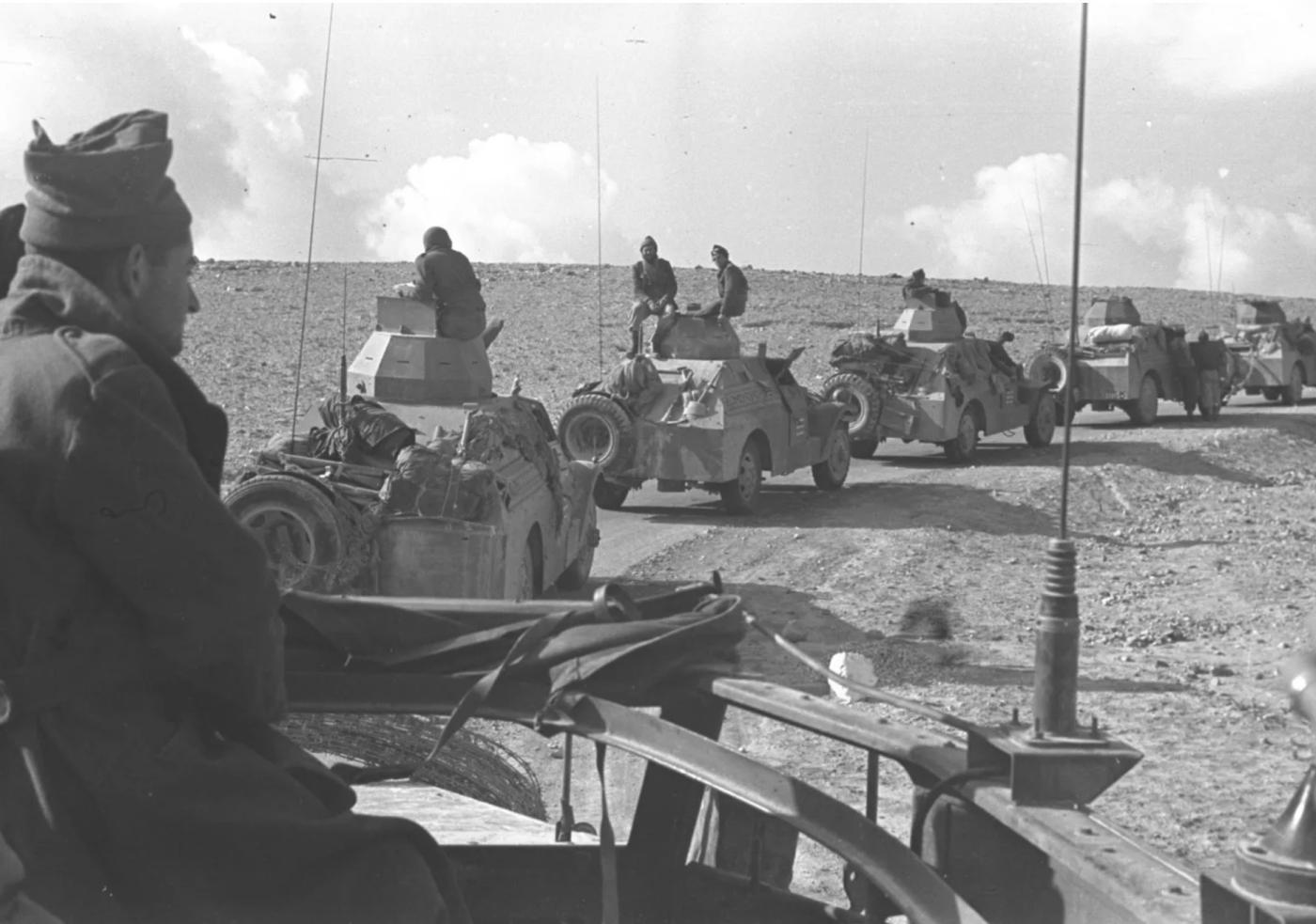
The Egyptian force included British-supplied equipment left over from the Second World War period. Its armour included a battalion equipped with British Light Tank Mk VI vehicles and Matilda tanks. The Matilda was a heavily armoured infantry tank by earlier wartime standards, though by 1948 it was no longer modern. The lighter Mk VI tanks were faster but much more vulnerable. Alongside these were armoured cars and carriers used for reconnaissance, troop movement and support on the coastal road.
The artillery arm was also important to the Egyptian advance. The force included a battalion of sixteen 25-pounder field guns, one of the standard British artillery pieces of the Second World War, as well as a battalion of eight 6-pounder anti-tank guns. Other accounts describe three 25-pounder batteries, one 18-pounder battery and a 6-pounder anti-tank battery, showing that the exact breakdown varies slightly between sources. The important point is that the Egyptians entered Gaza with proper artillery support, anti-tank weapons, machine-gun units and armoured elements, giving them a clear firepower advantage over many of the lightly armed Israeli settlements and defensive positions they first encountered.
Egypt also had air support. The Royal Egyptian Air Force possessed Spitfires, several Hawker Hurricanes and C-47 transport aircraft converted for bombing use. These aircraft were used during the early stages of the war to attack Israeli positions and support ground operations. In May 1948, Israel’s air arm was still very small and improvised, so Egyptian aircraft initially represented a serious threat.
From Gaza, the Egyptian plan was to advance north along the coastal road toward Majdal, Ashdod and eventually the approaches to Tel Aviv, while also threatening Israeli settlements in the Negev. Egyptian columns attacked places such as Nirim, Kfar Darom and later Yad Mordechai. These settlements were small and lightly defended, but their resistance delayed the Egyptian advance and gave Israeli forces valuable time to organise stronger defences further north.
The entry into Gaza was therefore more than just a local movement of troops. It was the beginning of Egypt’s main campaign in the 1948 war. Gaza became the Egyptian army’s forward base, supply route and political foothold in southern Palestine. Although the Egyptian army had tanks, artillery, aircraft and thousands of regular troops, its campaign soon became slowed by stiff resistance, stretched supply lines and uncertain command aims. By the end of the war, Egypt had failed to reach Tel Aviv, but it did hold the Gaza Strip, which remained under Egyptian control after the armistice of 1949.